

SAM Web Studio · Hire Node.js Developers
Hire Node.js Developers for Your Backend and APIs
Node.js runs many of the services behind modern web and mobile products: APIs, integrations, webhooks and the jobs that move data between systems. When your team owns a Node.js backend and has more work than people, we can propose a developer from our team to join it, working in JavaScript or TypeScript from your backlog and engaged through SAM Web Studio.
- REST APIs
- Authentication & Permissions
- Third-party Integrations
- Webhooks
- Data Processing

Rated by clients
4.3–5.0across 6 review platforms






When to add a Node.js developer
Teams usually look for Node.js capacity when a backend has grown beyond what the front-end developers can look after, when integrations with other systems keep multiplying, or when a single backend developer has become a bottleneck. A dedicated developer suits continuing work where your team sets the priorities and reviews the results.
What they can work on
Typical work includes REST APIs, authentication and permissions, integrations with payment, CRM, messaging and other third-party services, webhook handlers, data processing, database access, and fixes to existing services. Where the project already runs background processes, scheduled jobs or real-time features, those can be part of the work too.
Node.js, Express or NestJS?
Node.js backends vary widely: some use Express or a similar lightweight framework, some are built on NestJS, and some have grown their own structure over time. This page covers general Node.js backend work. If your backend is built on NestJS and you need someone fluent in its modules, providers, guards and dependency injection, see hiring NestJS developers instead.
How Node.js backends are usually built
- Express or a similar lightweight framework
- A structure the project has grown over time
- NestJS — see Hire NestJS Developers
Joining an existing backend
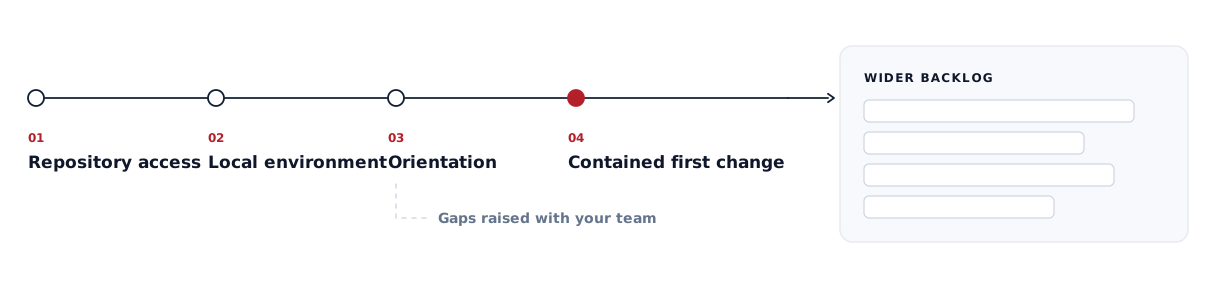
The first days usually involve repository access, a working local environment, and a walk through the main services, routes, data layer, dependencies and deployment steps. A first contained change — a fix with a clear reproduction, or a small endpoint — shows quickly whether the setup and conventions are understood. Backends built quickly often have gaps such as missing error handling, secrets in code or external calls without timeouts; these are noted and raised so your team can decide what to fix and when, rather than discovering them during an outage. How long orientation takes depends on the size and state of the codebase.
JavaScript and TypeScript
Many Node.js teams are adopting TypeScript for safer changes and clearer contracts between services, but it is not a requirement. Work happens in whichever language your project uses. If your team wants to introduce TypeScript, it can be done gradually, without rewriting working code for its own sake.
APIs other teams depend on
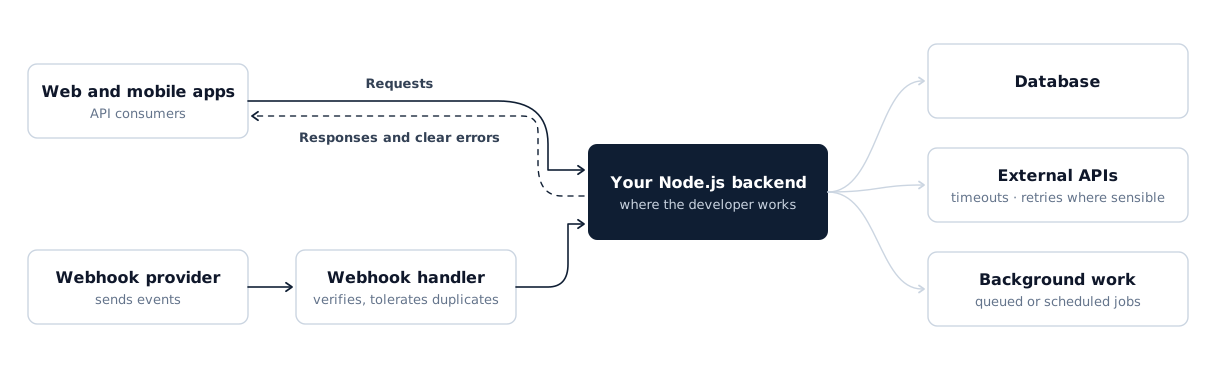
A Node.js developer often sits between the front-end or mobile developers who consume the APIs and whoever runs the infrastructure. Consistent response shapes, clear error responses and early warning of changes that affect other teams matter as much as the code. Where the project versions its APIs, breaking changes follow that approach; where it does not, they are agreed with the consumers before release.
Webhooks and third-party APIs
Integrations are a large share of Node.js work: payment callbacks, CRM updates, messaging, shipping and analytics. Providers retry failed deliveries, send duplicate events and slow down without warning. Integration work takes those cases into account — idempotent handling where the provider's events allow it, timeouts and retries where they make sense, and enough logging to investigate when something goes wrong — within the scope agreed for each integration.
Performance and the event loop
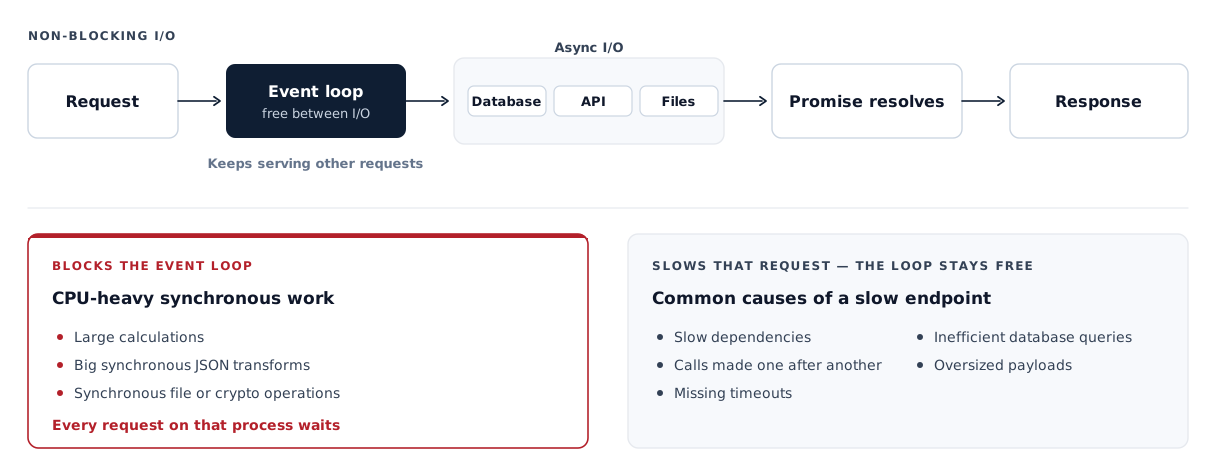
Node.js is well suited to I/O-bound work such as APIs that spend most of their time waiting on databases and other services. Its weak point is CPU-heavy synchronous work — large computations, big JSON transformations, synchronous file or crypto operations — which blocks the event loop and slows every request on that process. Individual endpoints are also commonly slowed by external calls made one after another instead of in parallel, missing timeouts, oversized payloads and inefficient database queries.
Finding and fixing these in application code is part of the role; load testing, capacity planning and infrastructure scaling are separate unless agreed.
Errors and logging
Node.js services can fail quietly: a rejected promise nobody handles, a webhook that times out, an error swallowed by a catch block. Consistent error handling and useful logging are added or improved in the code being worked on, so problems appear in your logs rather than in customer complaints.
Setting up monitoring platforms, dashboards and alerting is separate unless it is part of the agreed scope.
Data and databases
Node.js backends work with many data layers — relational databases such as MySQL or PostgreSQL, document stores, caches — through a range of drivers and ORMs. The developer works with whatever the project already uses, keeps queries and migrations consistent, and raises it when the data model itself is causing problems.
Database server administration is not part of the role.
Real-time features
Some products need live updates — chat, notifications, dashboards that refresh without reloading — often built with WebSockets or similar approaches in Node.js. Existing real-time features can be maintained and extended as part of ongoing work.
Designing a new real-time system, or scaling the infrastructure behind one, is discussed and planned rather than assumed.
Dependencies and upgrades
Node.js projects accumulate many packages, and Node itself moves through versions that eventually lose support. Within the agreed scope, dependencies are kept reasonably current and security advisories that affect your project are checked and raised.
Larger upgrades, such as a major Node version change or a framework upgrade, need planning and testing and are agreed as separate pieces of work.
Security in everyday work
Many backend security problems are ordinary: missing input validation, overly broad permissions, secrets committed to repositories, outdated packages with known vulnerabilities. Sound defaults are applied in the code the developer works on, and known weaknesses are flagged to your team.
This is not a security audit or penetration test; those are separate pieces of work.
Quality expectations
We expect readable code, validated inputs, explicit error handling, sensible timeouts on external calls and configuration kept out of the codebase. Existing automated tests are maintained, and focused tests can be added around risky changes. For the parts of the service they change, the developer keeps README notes, environment variable lists and API notes current, so the next person does not have to rediscover how things work.
Independent review and QA are not automatic unless your team provides them or they are scoped separately.
Deployments and infrastructure
Work happens within your existing deployment process, process manager and environment configuration. Server provisioning, containers and orchestration, CI/CD pipelines, reverse proxies, load balancers and cloud architecture are not part of this role. If your servers need managing, that is covered by our hosting and infrastructure work or your own operations team.
What is not included automatically
Separate unless agreed
- Front-end development
- Infrastructure and DevOps
- Database administration
- Independent QA
- Security audits
- Project management
Third-party service fees and licences stay with you unless the terms say otherwise.
Developer or Node.js project?
If you want SAM to design and deliver a Node.js backend as a project, rather than add a developer to your team, see our Node.js development service. A dedicated developer suits continuing work that your team directs.
Hire a Node.js developer
Hire a developer for continuing work your team directs.
Node.js development service
Use the service when you want SAM to own delivery of a defined backend.
Related
- Hire Dedicated ResourcesOther specialists, and how a dedicated engagement works.
- Node.js DevelopmentA Node.js backend with SAM responsible for delivery.
- Hire NestJS DevelopersFor backends built on the NestJS framework.
Our Node.js experience
Capability areas
- APIs
- Integrations and webhooks
- Backend services
- JavaScript and TypeScript
Our team builds and maintains Node.js services as part of our platform and application work. We are not presenting a named public case study on this page, and that experience does not by itself mean a particular developer is free on a given date.
Hire Node.js Developers FAQs
Hire Node.js Developers
Need Node.js capacity?
Describe your backend, the systems it connects to and the work ahead. We will review the requirement, confirm suitable availability and explain how the engagement could work.


