

SAM Web Studio · Hire NestJS Developers
Hire NestJS Developers for Structured TypeScript Backends
NestJS gives a Node.js backend a deliberate shape: modules, dependency injection, and a clear place for validation, access control and error handling. That shape only pays off if the people extending the backend work with it rather than around it. If your team runs a NestJS backend and needs more capacity, we can review your requirement and propose a NestJS developer from our team, where suitable availability exists, to work from your backlog, engaged through SAM Web Studio.
- Modules & Endpoints
- Guards & Permissions
- DTO Validation
- Interceptors & Filters
- Tests & Configuration

Rated by clients
4.3–5.0across 6 review platforms






Why a NestJS specialist, not just a Node.js developer
General Node.js experience is not the same as knowing NestJS well. A developer unfamiliar with Nest's module system, providers and decorators tends to write plain Node.js inside a Nest project — services instantiated by hand, validation scattered through controllers — and the structure slowly erodes. A specialist makes sense when your backend is already built on Nest, or when you have chosen it for a new service and want it built consistently from the start. If your backend uses Express or its own structure, a general Node.js developer is usually the better match.
What they work on
Typical work includes new modules, controllers and endpoints; services and providers; request validation with DTOs and pipes; authentication and authorisation with guards; interceptors for logging, caching or response shaping; exception filters; database access through the data layer your project uses; configuration; and tests for the parts your team wants covered.
Working within the framework
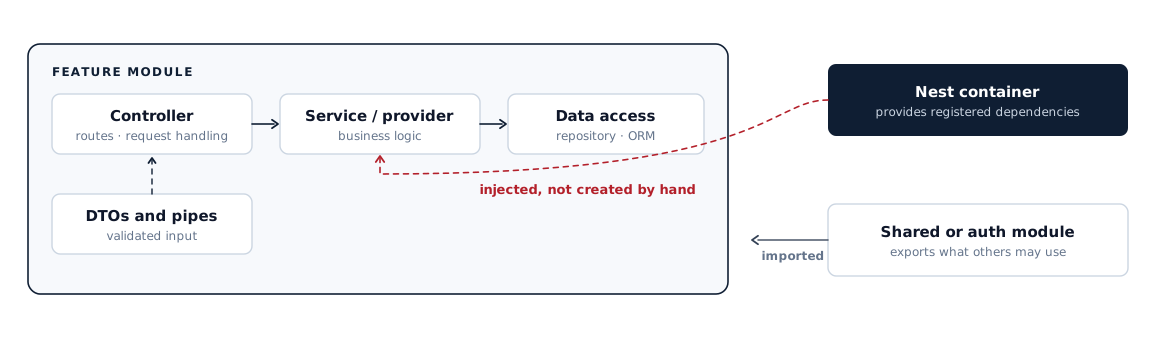
Much of NestJS's value comes from consistency: related features grouped into modules, dependencies provided through the container rather than created ad hoc, and cross-cutting concerns such as logging or error formatting handled in one place. Nest allows more than one valid way to organise a project, so the aim is to follow the conventions your codebase already uses, not to impose a textbook layout. As an application grows, modules can become tangled and shared code can spread; raising that early and proposing targeted refactoring is usually better than letting it drift towards a rewrite.
Access control and validation
Access control and input validation are where backend mistakes become security problems. In NestJS these usually sit in guards, pipes and validated DTOs, sometimes alongside role or policy checks in services. Keeping these rules consistent and easy to find reduces the chance of a new endpoint skipping them — though validation alone does not make an API secure, and projects vary in how authentication is implemented. The developer works with your existing approach and flags gaps they come across.
This is not a security audit or penetration test; those are separate pieces of work.
Data access and performance
NestJS projects use different data layers — TypeORM, Prisma, Mongoose and others are common examples, and the framework does not require any of them. The developer works with whatever is already in place, keeps entities and migrations consistent, and keeps database concerns out of controllers. When endpoints are slow, the cause is more often data access or downstream calls than the framework itself: repeated queries, missing indexes, external calls made one after another, large payloads, or CPU-heavy work blocking Node's event loop. Fixing these in application code is part of the role.
Load testing, infrastructure scaling and database server administration, replication or backups are separate unless agreed.
Configuration, testing and documentation
A backend that behaves differently between development, staging and production is hard to trust. Configuration stays in environment settings rather than code, validated at start-up where the project does so. Nest's dependency injection makes services straightforward to test in isolation: existing tests are extended alongside new features, and where coverage is thin, focused tests can start with the modules your team considers most critical, such as authentication, payments or imports. Independent QA is not included automatically. If API documentation is generated from decorators or maintained separately, it is kept current with each change so front-end and mobile developers are not reverse-engineering endpoints.
Queues, scheduled jobs and microservice patterns
Some NestJS backends use queues or scheduled tasks for emails, imports and reports, and some already use Nest's microservice transports to talk to other services. Where an existing system uses these, the developer can work on the processors, jobs and handlers within the agreed scope, and check that jobs run and failures are visible where they have access to do so.
Setting up or running queue infrastructure, message brokers or worker processes — and designing a microservices or event-driven architecture — are separate pieces of work.
APIs for front-end and mobile teams
NestJS backends often serve Next.js or mobile front ends. Consistent response shapes, clear error responses and predictable pagination make those teams faster. API changes are agreed with the people who consume them before release, and breaking changes follow the project's versioning approach where it has one.
Joining an existing NestJS application
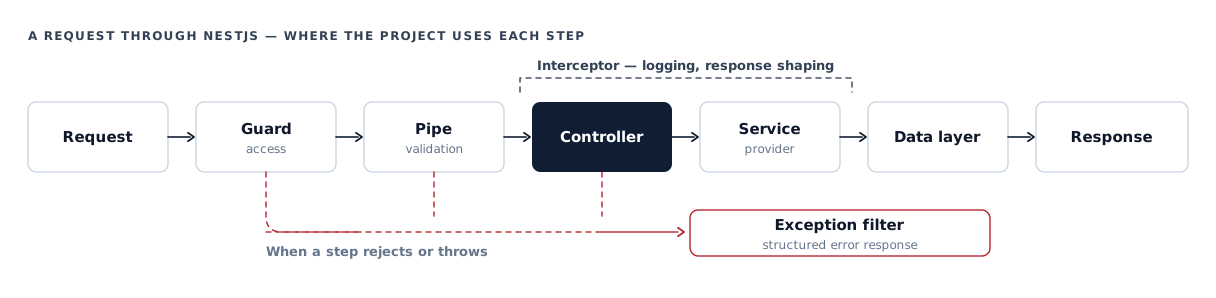
Onboarding starts with repository access, a working local environment and a walk through the module structure, configuration, database layer, authentication setup and how a typical request flows through guards, pipes and interceptors. A first contained task — a new endpoint in an existing module, or a fix with a clear reproduction — shows quickly whether the setup and conventions are understood. How long this takes depends on the size and condition of the codebase.
Boundaries
Work happens within your existing deployment process, environment configuration and service topology.
Separate unless agreed
- Server provisioning
- Containers and orchestration
- CI/CD pipelines
- Reverse proxies and load balancers
- Cloud architecture
- Queue infrastructure
- Observability platforms
- Front-end development
- Independent QA
- Project management
If your servers need managing, that is covered by our hosting and infrastructure work or your own operations team.
Developer or NestJS project?
If you want SAM to design and deliver a NestJS backend as a project — architecture, build and launch — rather than add a developer to your team, see our NestJS development service. A dedicated developer suits continuing work that your team directs.
Hire a NestJS developer
Hire a developer for work your team directs.
NestJS development service
Use the service when you want SAM to own delivery.
Related
- Hire Dedicated ResourcesOther specialists, and how a dedicated engagement works.
- NestJS DevelopmentA NestJS backend with SAM responsible for delivery.
- Hire Node.js DevelopersFor Express or custom Node.js backends.
Our NestJS experience
Capability areas
- Modules and providers
- API access control
- Validation
- Structured TypeScript backends
- Testing and configuration
Our team uses NestJS in internal platform work and structured TypeScript backends, including modular APIs with role-based access consumed by Next.js front ends. We are not presenting a named public client case study on this page, and that experience does not by itself mean a particular developer is free on a given date.
Hire NestJS Developers FAQs
Hire NestJS Developers
Need NestJS capacity?
Tell us about your backend, how it is structured and the work ahead. We will review the requirement, confirm suitable availability and explain how the engagement could work.


