

SAM Web Studio · Backend & API Engineering
NestJS Development Services for Backends That Outlive Their First Team
We design and build NestJS development services — APIs, integration layers and backend systems for products where the architecture has to be decided before the first endpoint, not discovered around it.
- Since 2012
- Modular Architecture
- Async & Queue Processing
- Security by Design
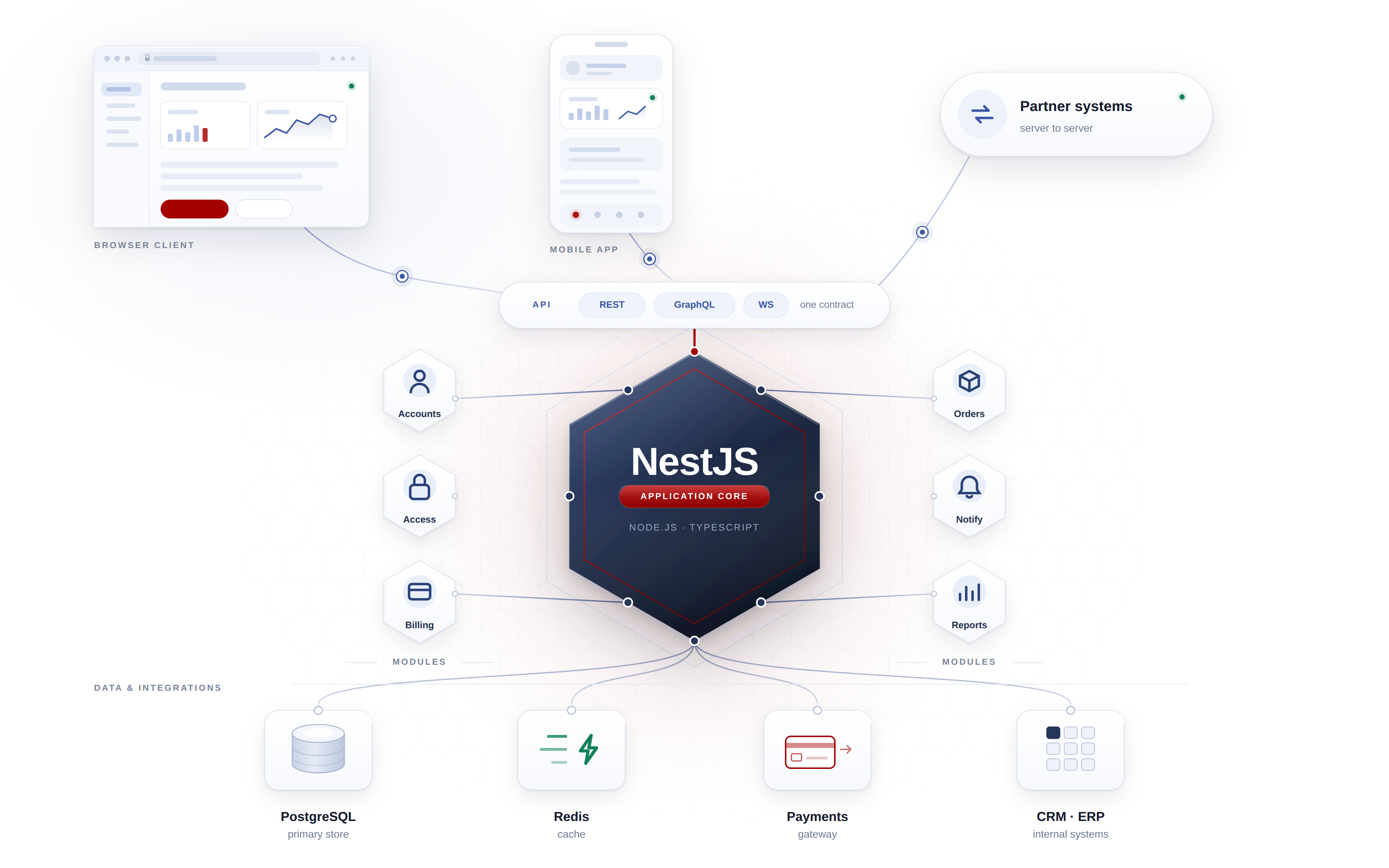
We design and build NestJS development services — APIs, integration layers and backend systems for products where the architecture has to be decided before the first endpoint, not discovered around it.
The commercial case for NestJS
NestJS is a framework for building server-side applications on Node.js, written in TypeScript. What makes it a commercial decision rather than a technical preference is that it supplies an architecture. Modules, providers, an injection container and a fixed request path arrive with the framework instead of being invented per project, so what a team decides is what goes inside them. That is what makes the second developer, and the second year, cheaper.
-
A codebase your next hire can already read
An unstructured Node service accumulates its own conventions, and they leave with the person who set them. NestJS supplies them instead, so a developer who has used it elsewhere can read yours. That is not a small commercial property — it is most of what "maintainable" means when you are hiring.
-
Types and tests, as consequences of the design
The framework is built with TypeScript and its patterns assume it. Types run through the service layer to the controller, so a renamed field breaks the build rather than a customer's integration. Nothing about this is automatic: it holds only where the team keeps types honest at the boundaries, which is a code-review discipline rather than a framework feature.
Testing falls out of the same design. Dependencies arrive through the constructor rather than being created inside the class, so a test can substitute a database or a payment gateway without touching the code under test. The design makes tests cheap to write; whether they get written is a delivery decision, and we treat it as one.
-
One service layer, many ways in
The same service layer can sit behind a REST controller, a GraphQL resolver, a WebSocket gateway, or a message-based microservice, because the business logic is separated from how a request arrives. Adding a channel later stops meaning rewriting the logic behind it.


How a NestJS application is organised
Modules draw the boundaries, and everything else follows from that
A module declares its controllers, its providers, what it imports from elsewhere and what it exports. Anything not exported stays private to that module — the encapsulation that keeps a codebase from becoming a single, mutually-dependent mass, and the reason a feature can later be extracted into its own service without unpicking half the application.
Modules are singletons by default: an exported provider is shared across the application rather than duplicated. That's what makes the second developer on a NestJS codebase cheaper than the second developer on an unstructured Node service — the conventions arrived with the framework instead of leaving with whoever set them.
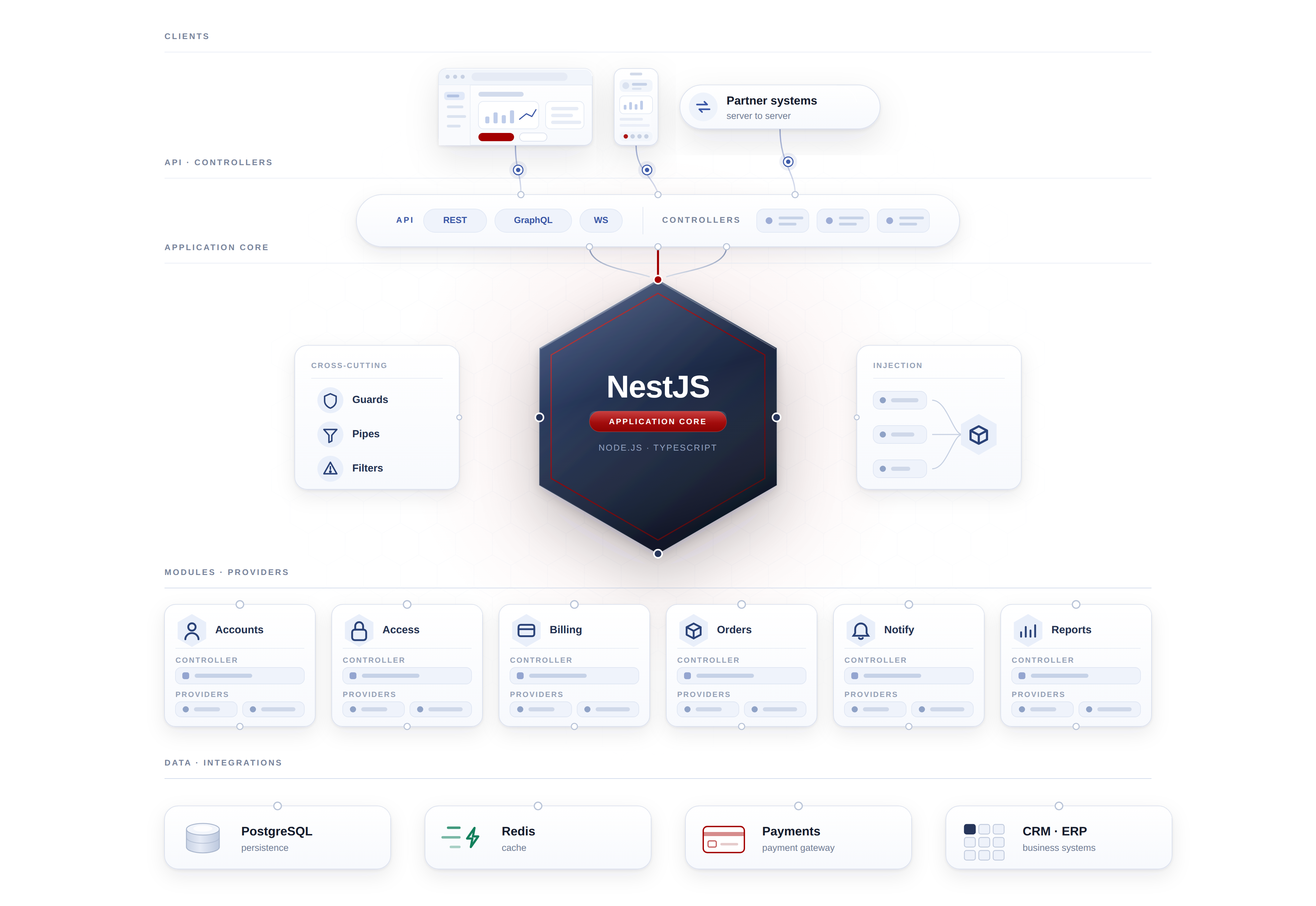
A request follows a fixed, inspectable path
Middleware, guards, interceptors and pipes — in that order, every time
A request passes through middleware, then guards, then interceptors, then pipes, before reaching the controller and the service beneath it — then back out through interceptors and, where something failed, exception filters.
Because that order is defined by the framework rather than by the order somebody happened to write things, authorisation, validation, logging and error shaping each have one obvious home. When a request behaves unexpectedly, there's a sequence to walk rather than a codebase to search.
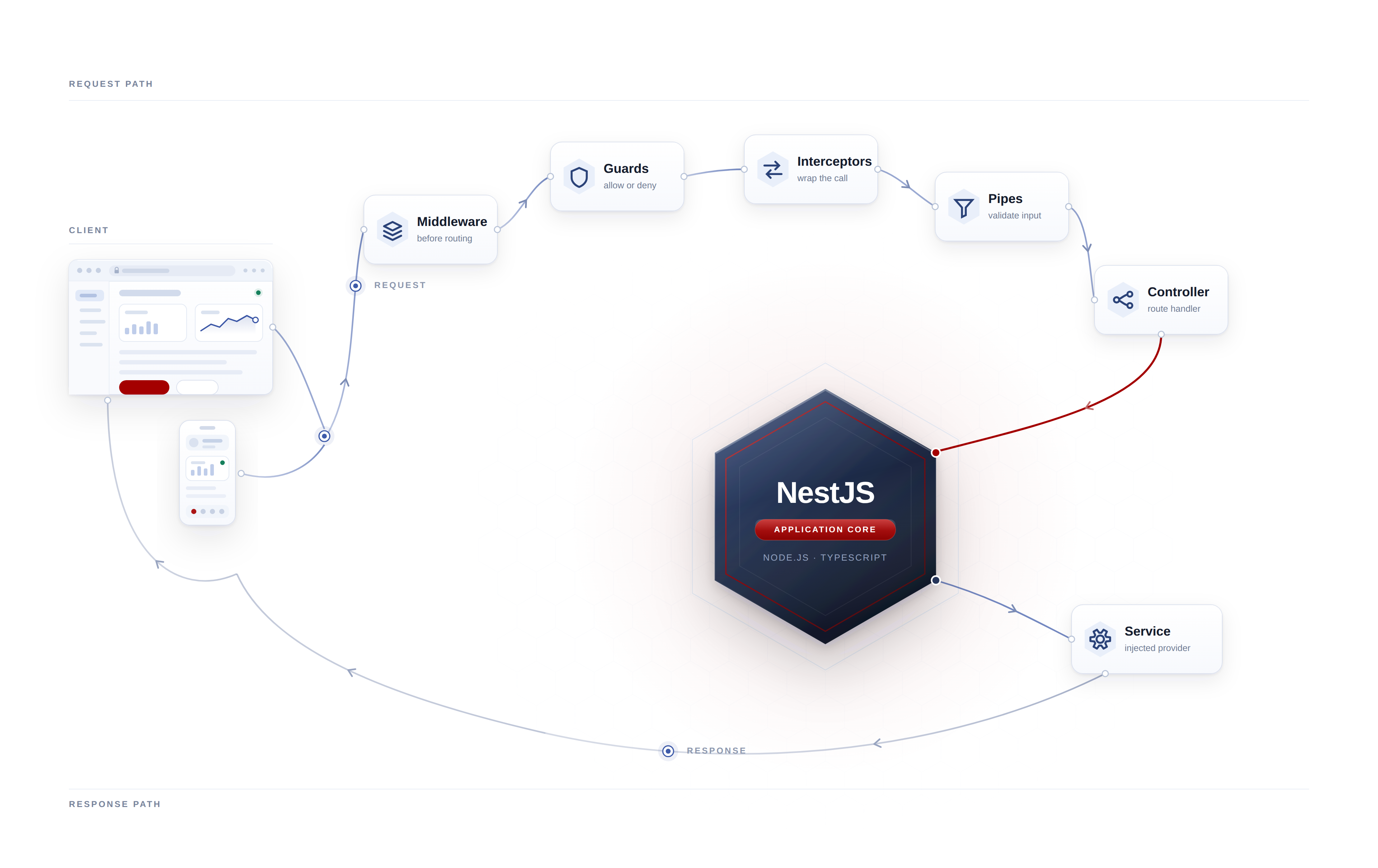
Dependency injection wires it together
Providers are registered once and resolved through the constructor
Classes marked injectable are managed by the framework's IoC container and delivered through constructors rather than created inside the class that needs them. Providers are singleton-scoped by default, created at bootstrap.
The practical effect: swapping an implementation is a configuration change, not a rewrite, and testing a class in isolation is routine — a test can substitute a database or a payment gateway without touching the code under test.
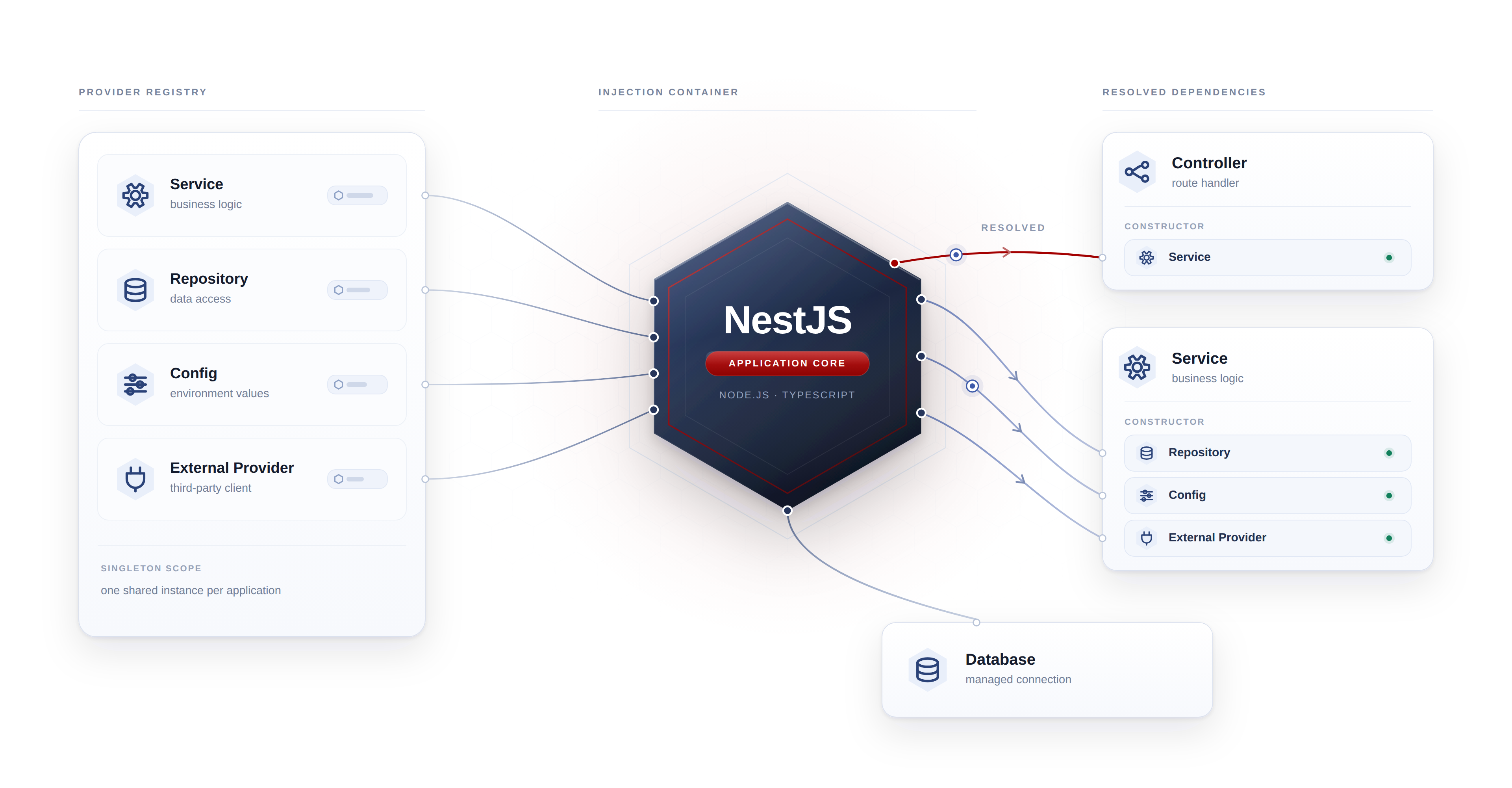
Work that shouldn't block a response
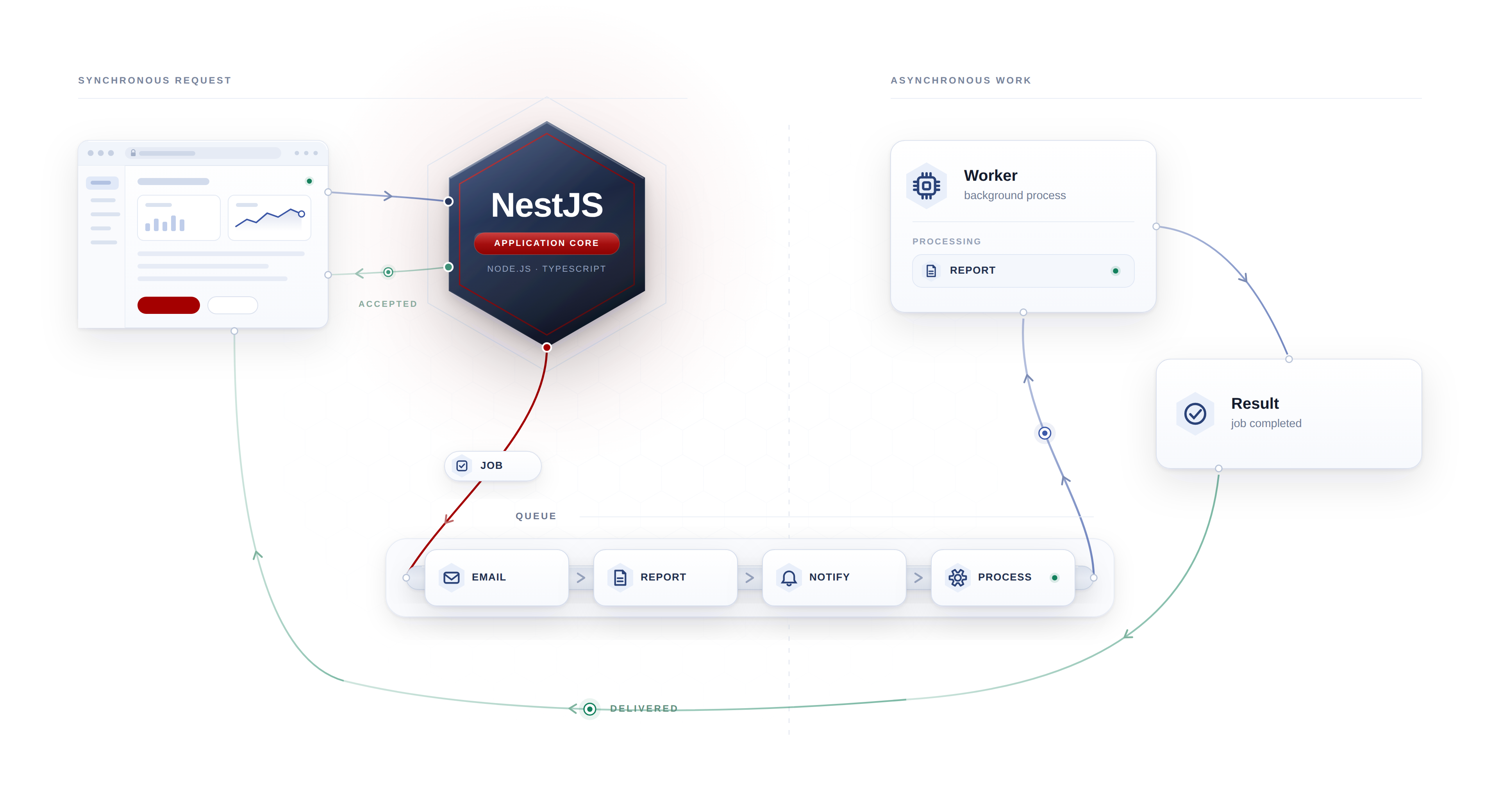
Queues, background jobs and scheduled processing, kept out of the request path
Queue workers, imports, exports, recurring jobs and event consumers don't belong in the request path — moving them to a queue means a slow third party degrades a background job rather than a user's page.
This is also where NestJS's scaling story is honest rather than promotional: no framework makes an application scale on its own. In practice the limit is almost never the framework — it's the database, or synchronous work sitting in the request path. Moving that work to a queue changes the shape of the problem more than any amount of tuning does.
Security decided at the architecture stage
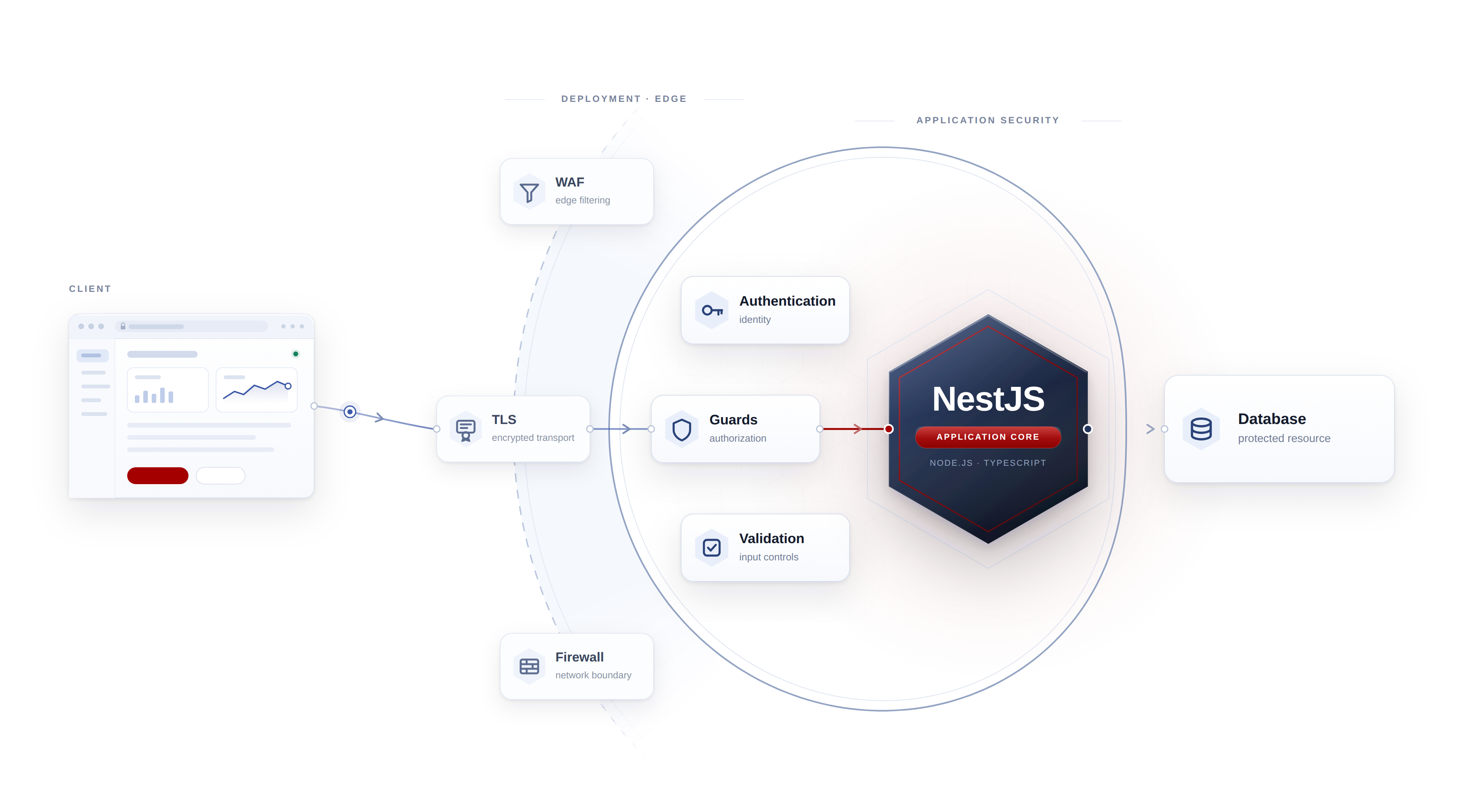
Retrofitting authentication and authorisation is where the cost lands
Guards run before the controller, which makes authorisation a declared property of a route rather than a check somebody remembered to write. Role and permission models are built against real job functions — on a backend, that's the whole of authorisation, not a refinement of it.
Validation pipes reject malformed input at the boundary. Exception filters ensure a failure returns a useful status without leaking internals into the response. Outside the code, a backend's callers are mostly other systems, so the risk concentrates in credentials — supplied per environment, never committed to the repository.
Deployment is routine, not an evening
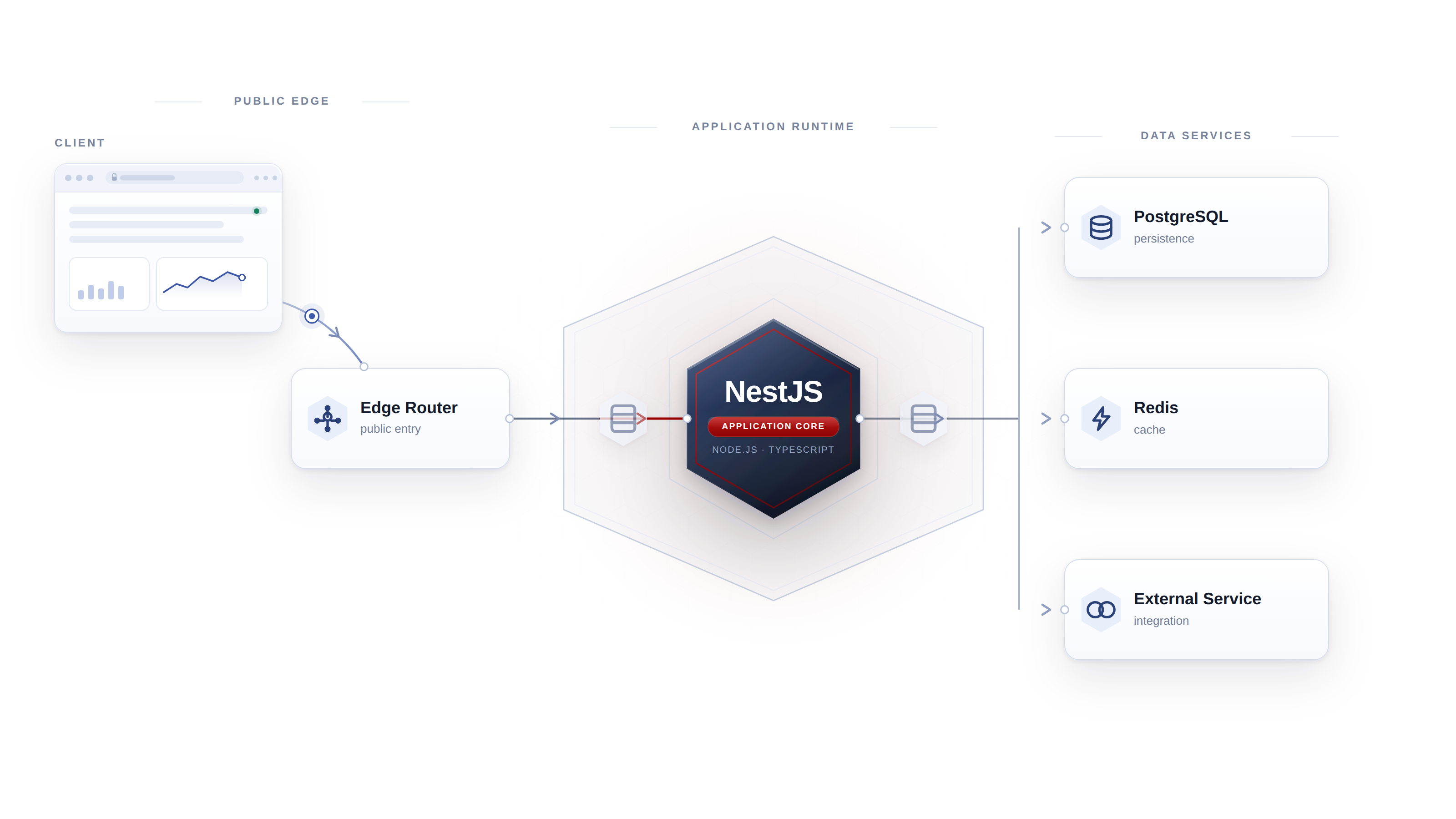
Docker and CI/CD, so a release can be performed the same way twice
Docker and GitHub Actions carry the delivery work where a project calls for them. The point of both is repeatability: the artefact that passed testing is the artefact that runs, and a release can be performed — or reversed — the same way twice.
A containerised NestJS service is portable by construction, which keeps the hosting decision reversible — AWS, or infrastructure you already operate and already audit, following your obligations rather than our convenience.
One core, many kinds of relationship
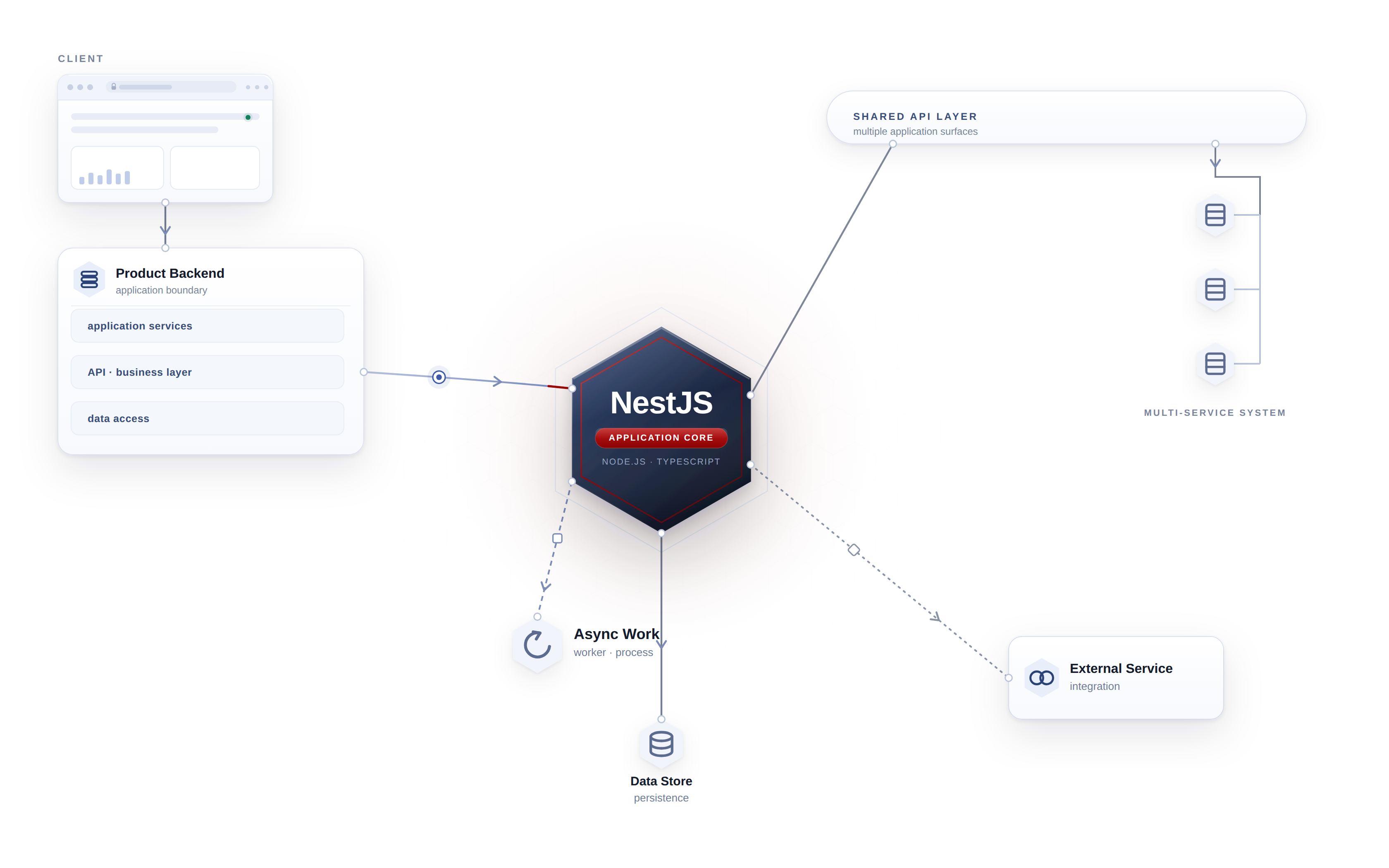
REST, GraphQL, WebSockets and service-to-service, from the same service layer
The same service layer can sit behind a REST controller, a GraphQL resolver, a WebSocket gateway or a message-based microservice, because business logic is separated from how a request arrives. REST remains the default for most systems — understood everywhere, cacheable, easy to debug. GraphQL earns its place where clients genuinely differ in what they need; WebSockets handle what's actually live, like presence or streaming status.
Where services do need to talk to each other, NestJS treats a microservice as an application using a transport other than HTTP, with support for TCP, Redis, MQTT, NATS, RabbitMQ, Kafka and gRPC. The transport is the easy decision — what happens when a message fails, arrives twice, or arrives out of order is answered in design, not by choosing from that list.
NestJS Development FAQs
NestJS is a framework for building server-side applications on Node.js. It is used for APIs, backend services behind web and mobile products, integration layers, background processing and message-based services. Its distinguishing feature is an opinionated modular architecture with dependency injection, which is why it is chosen for systems expected to grow and change hands.
Backend. NestJS builds APIs and services. It can render server-side views through a template engine, but that is not what teams adopt it for — its role is to supply the API layer, with a frontend framework such as React or Next.js consuming it.
Not always. Next.js runs server-side code of its own, and for content-driven sites or products with modest data needs that is often sufficient. A separate NestJS service earns its place when several clients share one API, when work must happen outside a request, when business logic deserves its own tests and release cycle, or when protocols beyond HTTP are involved.
It supports them directly. In NestJS a microservice is an application using a transport other than HTTP, with built-in support for TCP, Redis, MQTT, NATS, RabbitMQ, Kafka and gRPC. Whether you should use microservices is a separate question — most teams are better served by a well-structured single service until organisational scale makes the split worthwhile.
No framework does that on its own. Scalability comes from architecture and implementation: database design and indexing, caching, moving slow work to queues, and the ability to run more instances behind a load balancer. NestJS supports that architecture well; it does not supply it.
Yes. NestJS is not tied to a particular database and integrates with PostgreSQL, MySQL and other stores through the ORM or query layer that suits the project. It is well suited to sitting as an API layer in front of systems that already exist, including PHP and Laravel applications that continue to run.
Endpoint count predicts very little. The schedule is set by how many systems the service has to reach, how many of them you control, and how long you wait for access to the ones you do not. Twelve endpoints against a legacy ERP behind somebody else's change process is a longer project than forty against a database you already own. The estimate worth asking for names those dependencies.
Three situations. A small service that will stay small pays for structure it never draws on — modules, providers and injection are cost until something grows into them. A team with no TypeScript experience and no intention of hiring for it inherits a codebase only its author can safely change. And an application whose data needs Next.js already meets gains a deployment, a network hop and a second repository in return for nothing. Where one applies, we would rather say so while the scope is being written than bill you for discovering it.


