

Website Design Cost in India: The 2026 Pricing Report
A business website in India costs ₹25,000 to ₹5,00,000+ in 2026. The final figure depends on scope, design complexity, integrations and content, not on page count. This…
 Manish BhardwajHead of Digital Marketing
In this article
- How were these figures compiled?
- What do web design agencies typically charge in India?
- What is the SAM Website Cost Index™ 2026?
- What does each pricing tier actually include?
- What does a Shopify store cost in India?
- What makes a website cost more?
- What is not included in a website quote?
- What does a website cost each year after launch?
- How often do website quotes overrun?
- Does location change the price?
- Can you build a website yourself with AI in 2026?
- How long does a website take to build?
- Freelancer, agency or in-house?
- How do you compare two website quotes?
- Is India cheaper than other markets?
- When should you not hire us?
- What can this report not tell you?
- Frequently asked questions
- Using and citing this report
The short answer. A business website in India costs ₹25,000 to ₹5,00,000+ in 2026. The final figure depends on scope, design complexity, integrations and content, not on page count. The SAM Website Cost Index™ 2026 sets out five pricing tiers, what each tier includes, and what moves a quote upward.
Disclosure. SAM Web Studio is a web design and development company based in New Delhi, working with Indian and overseas clients since 2012. We sell the services priced in this report, so we are not a neutral party. Our own bands are labelled as ours. Wider market figures are described as typical ranges, drawn from pricing that agencies publish openly and from what we observe in competitive situations — not from formal research.
In short
- Five tiers cover most Indian business websites, from ₹25,000 to ₹5,00,000 and above.
- CRM, ERP, SaaS and mobile app work is quoted after discovery, never banded in advance.
- Scope, design complexity, integrations and content decide price far more than page count.
- Domain, hosting, licences, content, gateway fees and maintenance sit outside most quotes.
- Every figure here is a range current as of August 2026, not a fixed price.
How were these figures compiled?
The short answer. Our own bands come from work delivered since 2012 across a few hundred client projects. Wider market ranges reflect pricing that Indian agencies publish openly, plus what we see when competing for the same brief. They are presented as typical ranges, not as survey findings.
Most Indian agencies publish no prices at all. That single fact shapes the entire buying experience: at the research stage there is often nothing to compare, and the first number a buyer hears arrives with no context around it.
There are fair reasons for the silence. Scope varies genuinely between projects, and a published figure invites comparison against work that is not equivalent. The effect on the buyer is unchanged either way — the shortlist gets drawn on impressions rather than numbers.
This report takes the opposite approach. Our bands are published, the factors that move them are explained, and the exclusions are listed. You can hold any other proposal to the same standard.
What do web design agencies typically charge in India?
The short answer. Advertised starting prices in the Indian market commonly run from around ₹10,000 at the entry end to ₹1,00,000 and above for a considered business build. That spread reflects what each price covers, not the standard of work behind it.
The very low figures are real, but they buy a narrow product. Across the cheapest offers, these items are usually absent from the stated inclusions:
- More than four or five pages
- Any system that lets you edit the site yourself
- Copywriting — text is expected from you
- Search visibility work beyond a title tag and description
- Domain, hosting and SSL
- Testing beyond a single browser
- Support after handover
None of that makes a low price dishonest. It makes it incomparable. Two figures that differ tenfold often describe two different transactions, and nothing in the number itself reveals which.
Price is also a poor proxy for capability. A firm charging mid-range may be slower or less available than one charging more, and the reverse holds just as often. Nothing in this report ranks any company, and no firm is named or characterised.
Against that backdrop, here is our own pricing, set out in full.
What is the SAM Website Cost Index™ 2026?
The short answer. The Index sorts projects into five tiers — Starter, Growth, Professional, Enterprise and Custom — spanning ₹25,000 to ₹5,00,000 and above. Each tier states its typical inclusions, the businesses it suits, a realistic timeline and the technology behind it.
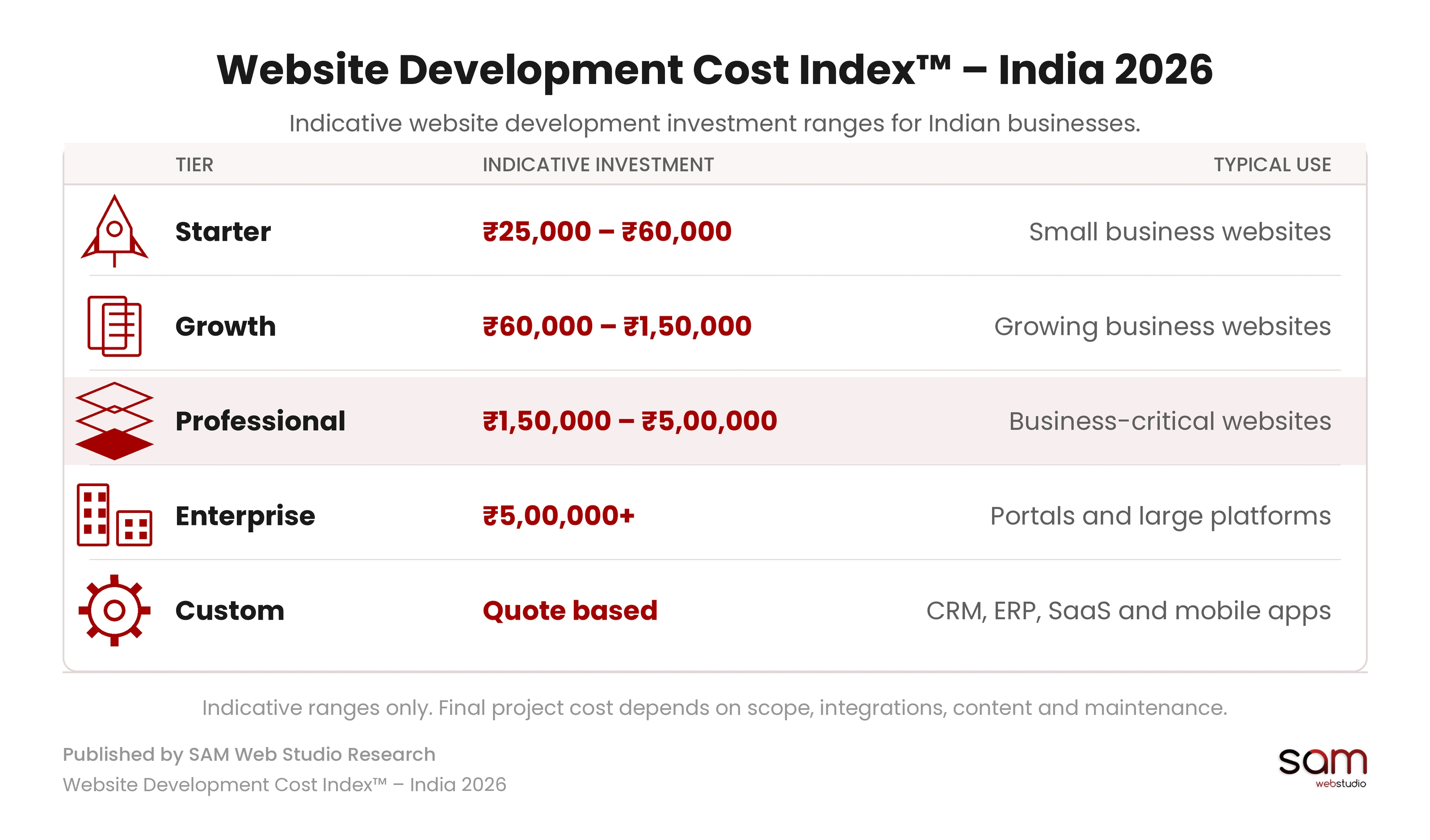
| Tier | Investment | Suitable for | Typical inclusions | Timeline | Technology |
|---|---|---|---|---|---|
| Starter | ₹25,000 – ₹60,000 | New and small local businesses, independent professionals | 5–8 pages, responsive build, enquiry form, basic on-page setup, SSL, analytics | 2–4 weeks | WordPress or a static build |
| Growth | ₹60,000 – ₹1,50,000 | Established SMEs, multi-service and B2B firms | 10–25 pages, full content management, blog, enquiry routing, structured data, speed pass | 4–7 weeks | WordPress or Laravel |
| Professional | ₹1,50,000 – ₹5,00,000+ | Businesses needing custom functionality, catalogues, member areas | Custom modules, role-based admin, payment or CRM integration, staging environment | 8–14 weeks | Laravel or another PHP framework |
| Enterprise | ₹5,00,000+ | Large organisations, portals, marketplaces | Multi-tenant architecture, single sign-on, API layer, audit logging, security review | 14–24 weeks+ | Laravel with a modern front end |
| Custom | Quote based | CRM, ERP, SaaS products; mobile applications | Scoped from paid discovery; nothing estimated before requirements exist | Discovery first | Framework and platform chosen at discovery |
Online stores sit outside this structure. A Shopify build runs ₹50,000 to ₹3,00,000 and above, spanning Growth and Professional, and is treated separately below because platform fees behave differently from build costs.
Three cautions before reading the tiers as a menu. Page count is the weakest signal in the table — a twelve-page site with three integrations belongs in Professional, while a twenty-five page brochure site sits comfortably in Growth. Timelines assume content arrives when agreed. The technology column is a recommendation shaped by requirements, not a rule.
A scope-specific estimate can be requested through our custom package form.
What does each pricing tier actually include?
The short answer. The tiers differ in function, not polish. Starter presents a business. Growth generates enquiries at scale. Professional runs part of the business. Enterprise serves large user populations. Custom builds a product.
Starter establishes that a business is real, findable and contactable. Five to eight pages from copy you supply, with an enquiry form, SSL and enough on-page setup to be found by name and by main service. It excludes editable-everywhere content management, multiple languages and integrations.
Below roughly ₹25,000, a website builder is the honest recommendation. No agency can deliver considered work at that level.
Growth is where most established businesses land. Ten to twenty-five pages, full content management, a blog, structured service and location pages, enquiry routing, structured data and Search Console configured at launch. It excludes bespoke functionality and role-based administration — a business needing either is buying an application rather than a website.
Professional is where a site stops being a brochure and starts doing work: custom modules, role-based administration, payment or customer-system integration, and a staging environment so changes are tested before they reach the public site.
Enterprise covers portal and multi-tenant projects with single sign-on, an API layer, approval workflows and staged deployment.
Custom work carries no band. Discovery establishes requirements, users, data model and integration surface first; a number produced before that would be a guess presented as an estimate. Discovery produces a requirements document, a build plan, a timeline and a fixed written quote — yours to keep whether or not you proceed.
Moving up a tier is frequently cheaper than staying put. Scope added mid-build is priced as change. Scope decided at the outset is priced once.
What does a Shopify store cost in India?
The short answer. A Shopify build in India runs ₹50,000 to ₹3,00,000+, depending on theme customisation, catalogue size, app integrations and migration. That covers the build alone. Subscription, tax, transaction fees and paid apps recur every month.
Build cost is driven by theme approach — configured, customised or bespoke — plus catalogue size and variants, each app connection, migration of product and order history, and who writes product copy.
Recurring costs to budget alongside the build:
- Platform subscription. Plans and rates change; check the official Shopify pricing page for current India figures before committing.
- GST. Applies to the subscription for Indian merchants at the prevailing rate.
- Payment gateway fees. Typically around 2% plus GST per transaction, varying by gateway and payment method.
- Additional platform transaction fee. Where Shopify's own payment product is unavailable in a market, a percentage fee applies on top of the gateway's.
- Paid apps. Each is a separate monthly charge, and they accumulate faster than most merchants expect.
- Domain. Renewed annually.
That extra transaction fee is the item most often missed. At meaningful volume it is not a rounding error, and it belongs in the model before the platform is chosen.
Shopify becomes expensive under three conditions: high transaction volume, heavy app dependence, or business logic the platform resists. Any of those warrants pricing a custom store against three years of total platform cost rather than against the build quote alone.
What makes a website cost more?
The short answer. Twelve factors decide where a quote lands. Scope and content move it most. Page count moves it least, despite being the figure buyers ask about first.
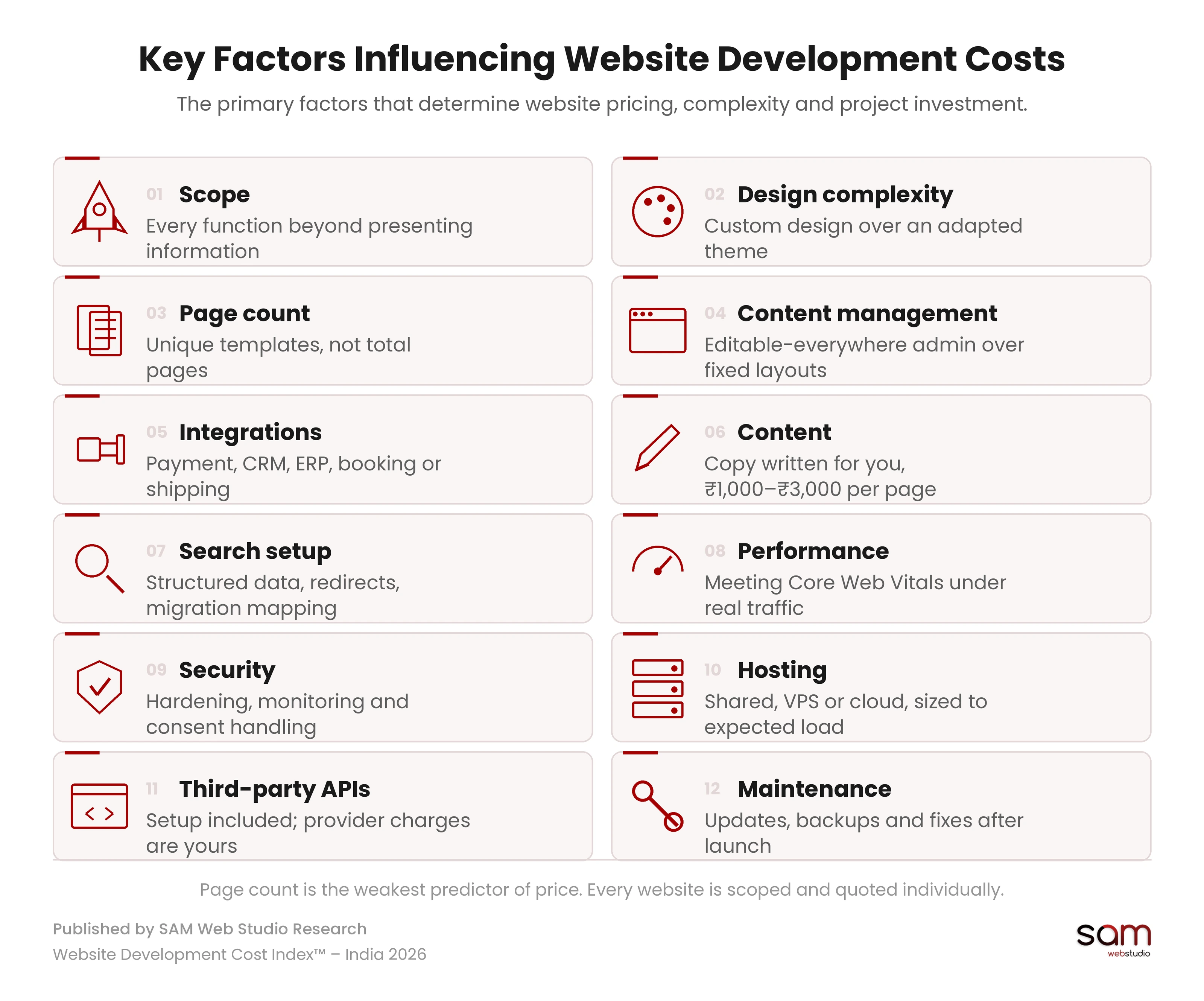
| Driver | What raises the price |
|---|---|
| Scope | Every function beyond presenting information |
| Design complexity | Custom design over an adapted theme |
| Page count | Unique templates, not total pages |
| Content management | Editable-everywhere admin over fixed layouts |
| Integrations | Each connector to payment, CRM, ERP, booking or shipping |
| Content | Copy written for you, typically ₹1,000–₹3,000 per page |
| Search setup | Structured data, redirects, migration mapping |
| Performance | Meeting Core Web Vitals under real traffic |
| Security | Hardening, monitoring and consent handling under the DPDP Act |
| Hosting | Shared, VPS or cloud, sized to expected load |
| Third-party APIs | Setup included; provider charges are yours |
| Maintenance | Updates, backups and fixes after launch |
Two of these catch people out consistently. Content, because supplying copy sounds straightforward until the deadline arrives. And integrations, because a connector configured in an afternoon can take a week to test properly against a live system.
Data protection is now a genuine line item rather than an afterthought. India's Digital Personal Data Protection framework is being brought into force in phases, and any site collecting enquiries needs a consent notice, a clear privacy policy and a process for handling requests. Current status is published by the Ministry of Electronics and Information Technology.
What is not included in a website quote?
The short answer. Most quotes exclude domain, hosting, SSL, theme and plugin licences, copywriting, photography, gateway fees, API charges, maintenance and training. None of it is hidden. It is simply unstated, and that gap is where first-year budgets break.
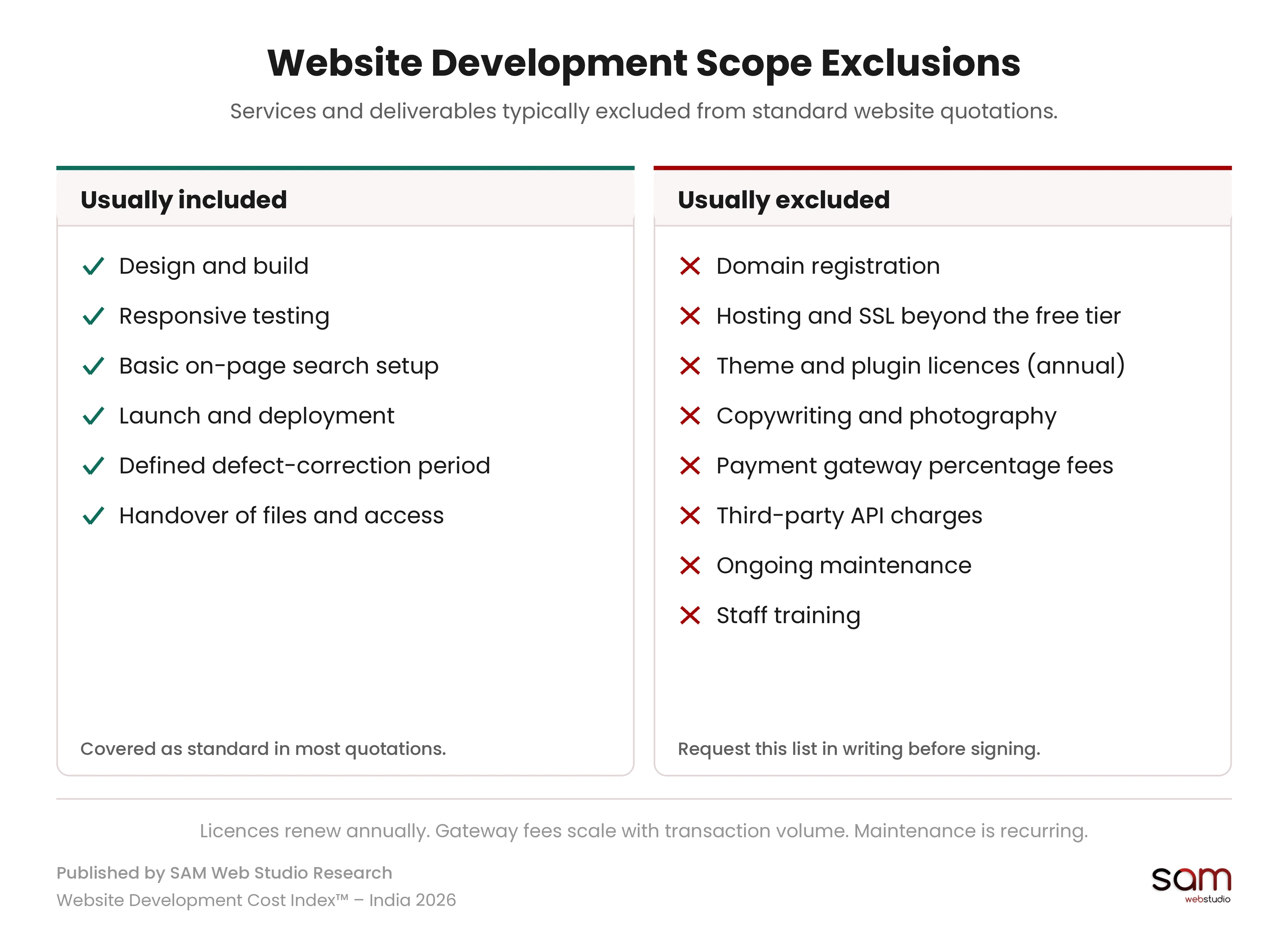
Usually included: design, build, responsive testing, basic search setup, launch, and a defined defect-correction period.
Usually excluded: domain registration, hosting, SSL beyond the free tier, premium theme and plugin licences renewing annually, copywriting, photography, payment gateway percentage fees, third-party API charges, ongoing maintenance and staff training.
Three items catch people most often. Licences, because they renew every year rather than once. Gateway fees, because they scale with success. Maintenance, because nothing appears wrong until something is.
Ask for the exclusions in writing before you sign. Anyone who cannot produce that list quickly has not thought about it.
What does a website cost each year after launch?
The short answer. Expect ₹20,000 to ₹75,000 a year for a small business website once hosting, domain renewal, SSL, software licences, backups, security monitoring and routine maintenance are included. Larger websites with premium plugins, higher traffic, custom integrations and proactive support can cost significantly more.
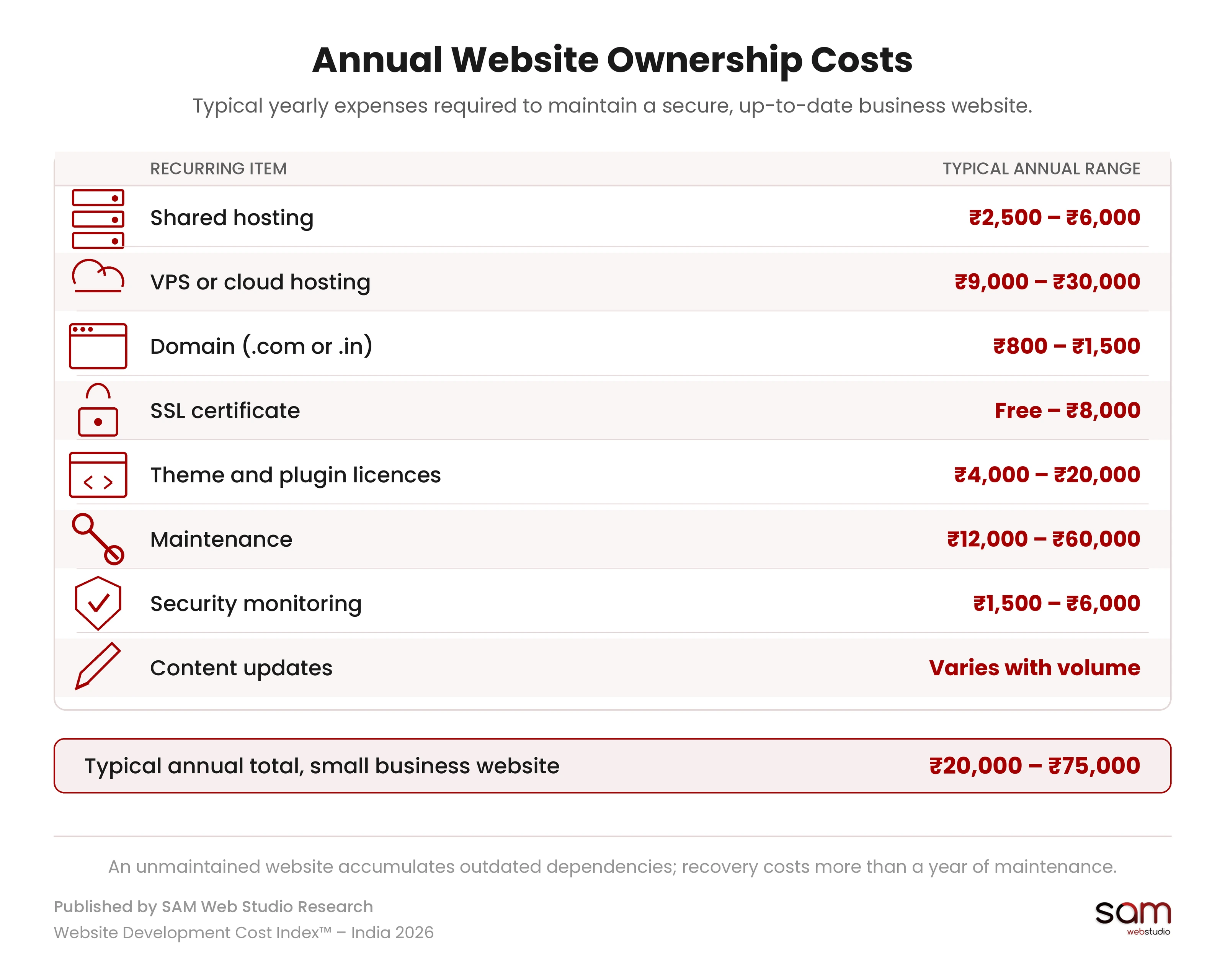
| Recurring item | Typical annual range |
|---|---|
| Shared hosting | ₹2,500 – ₹6,000 |
| VPS or cloud hosting | ₹9,000 – ₹30,000 |
| Domain (.com or .in) | ₹800 – ₹1,500 |
| SSL | Free with most hosts; ₹2,000 – ₹8,000 for paid certificates |
| Theme and plugin licences | ₹4,000 – ₹20,000 |
| Maintenance | ₹12,000 – ₹60,000 for small to mid-size sites |
| Security monitoring | ₹1,500 – ₹6,000 |
| Content updates | Varies with publishing volume |
An unmaintained site does not fail immediately. It accumulates outdated dependencies, then fails at an inconvenient moment — and recovery costs more than a year of maintenance would have.
How often do website quotes overrun?
The short answer. Overruns are common across the industry and rarely caused by bad faith. Scope decided during a build costs more than scope decided before it.
Three causes account for most of it, in our experience:
- Content arriving late, or in a different form than agreed, which stalls every dependent phase.
- Requirements assumed rather than stated — a feature obvious to the client but never written down.
- Third-party systems behaving differently in production than their documentation suggests.
All three are addressed the same way: a written scope agreed before work begins, with change-request pricing stated in the same document. That single habit prevents more disputes than any other.
Does location change the price?
The short answer. Location affects an agency's overheads more than its capability. Metro firms generally quote higher than those in smaller cities, but the gap reflects rent and salaries rather than skill.
Typical positioning across Indian markets:
- Delhi NCR, Mumbai and Bengaluru — highest published ranges, reflecting metro operating costs and a concentration of larger clients.
- Hyderabad, Pune and Chennai — broadly mid-range, with strong technical depth.
- Tier-two cities — lower published ranges, often with smaller teams and narrower service scope.
What location genuinely changes: response time in your working hours, the practicality of meeting in person, and familiarity with local market conventions. What it does not change: build quality. Remote delivery is now standard practice.
Can you build a website yourself with AI in 2026?
The short answer. For a few pages, occasional edits and no integrations, an AI-assisted website builder now produces a credible result for a fraction of agency cost. Below the Starter band, that is the honest recommendation.
Builders handle layout and starter copy well, produce responsive output by default, bundle hosting and SSL, and launch in hours rather than weeks.
They still struggle to connect to systems you already run, to migrate an existing site without losing search visibility, to handle consent properly under Indian data protection rules, and to give you portable ownership of what you have built.
The cost rarely counted is your own time. A builder subscription is modest. Forty hours of an owner's attention is not.
Use a builder when the site is small and static. Commission a build when the site has to do something.
How long does a website take to build?
The short answer. Starter builds take 2–4 weeks, Growth 4–7, Professional 8–14, and Enterprise 14–24 weeks or longer. Custom work is scoped after discovery. Every timeline assumes content arrives when agreed.
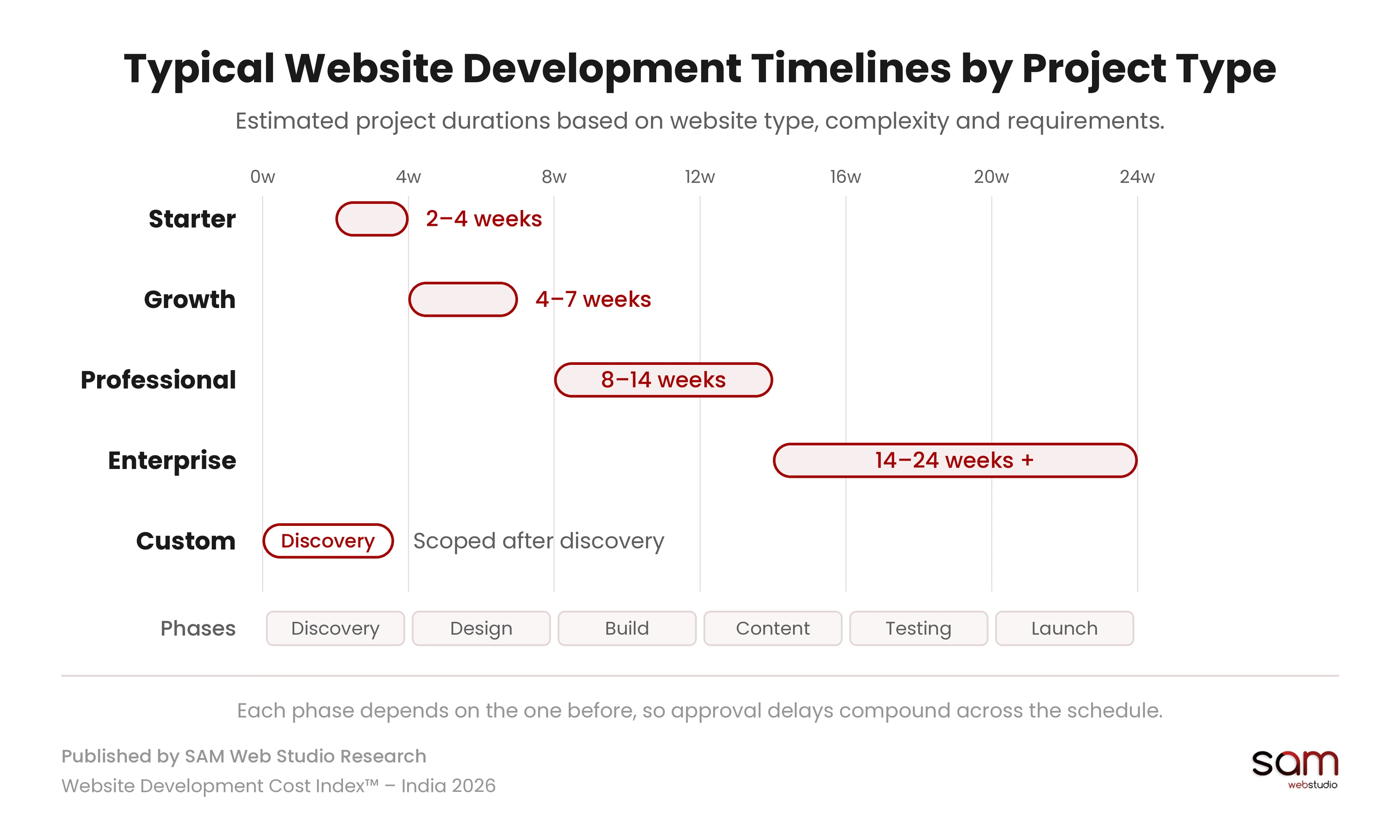
Discovery, design, build, content, testing and launch each depend on the phase before, so approval delays compound. A week lost at design approval is a week lost at launch.
What you control: supplying content on time, consolidating feedback into one response per round, and naming a single decision-maker.
Freelancer, agency or in-house?
The short answer. Freelancers suit small, well-defined projects you can manage yourself. Agencies suit builds needing several skills at once and continuity afterwards. In-house makes sense only when the site changes weekly.
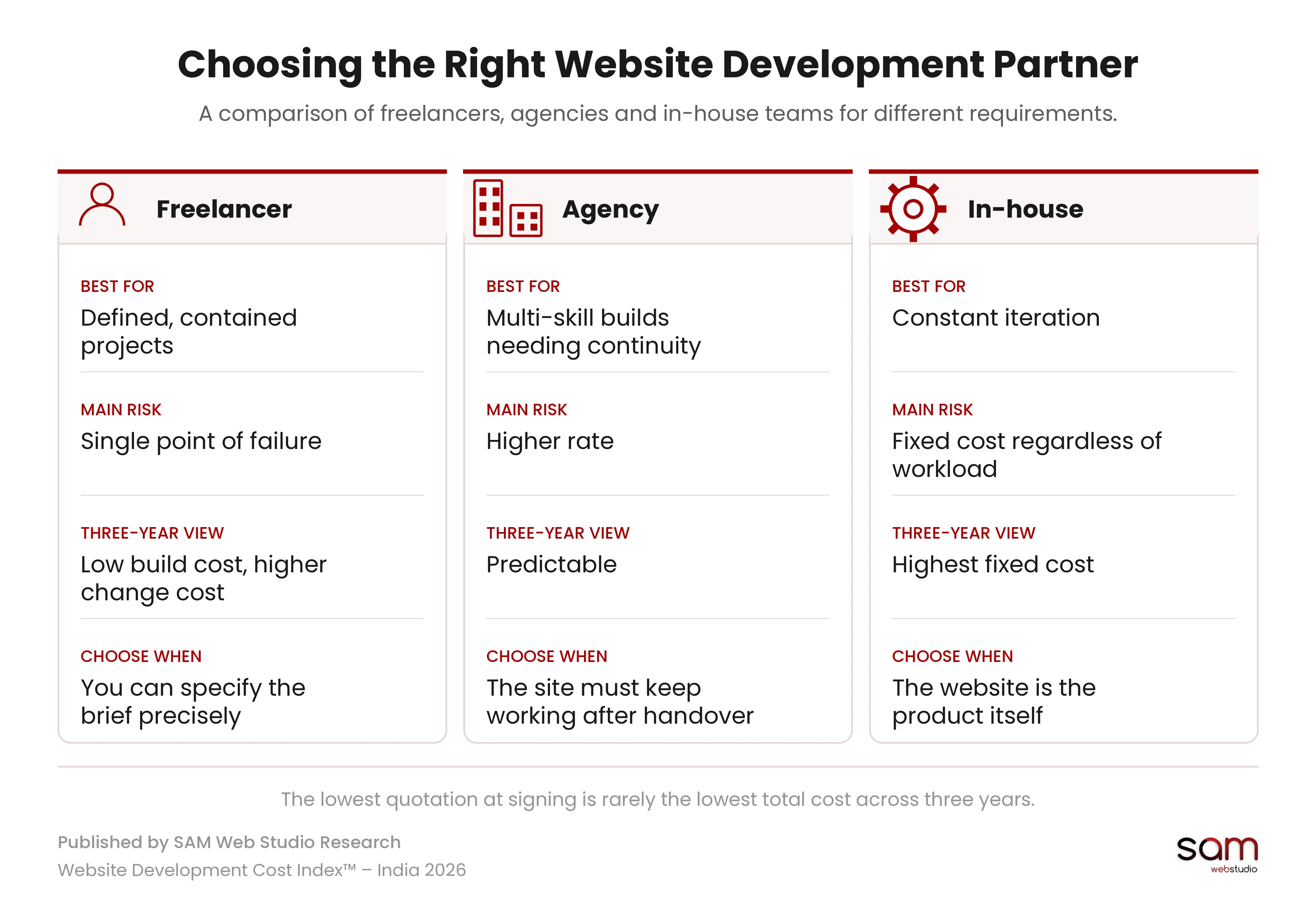
| Freelancer | Agency | In-house | |
|---|---|---|---|
| Best for | Defined, contained projects | Multi-skill builds needing continuity | Constant iteration |
| Main risk | Single point of failure | Higher rate | Fixed cost regardless of workload |
| Three-year view | Low build cost, higher change cost | Predictable | Highest fixed cost |
Choose a freelancer when you can specify the brief precisely. Choose an agency when you cannot, or when the site must keep working after handover. Build in-house when the website is the product itself.
We have written this decision up in full, with real cost bands, a five-factor scoring framework and eight worked business scenarios: whether to hire a company or a freelancer.
How do you compare two website quotes?
The short answer. Compare inclusions, not totals. Two proposals for the same brief often describe different transactions. Check each against the same line items, then price whatever goes unmentioned before deciding which is genuinely cheaper.
Check every quote for: page count, design approach, content management, who writes the copy, image sourcing, responsive testing scope, browser coverage, each integration named individually, search setup, structured data, redirects and migration, performance targets, security measures, consent handling, hosting arrangement, domain and SSL, licences and renewals, training, support period, and change-request pricing.
Whatever a quote does not mention is not free. It is either your responsibility or a change request later.
Is India cheaper than other markets?
The short answer. Published Indian rates sit below those in most Western markets, but a like-for-like comparison depends on what each market's figures cover. Pricing is set locally, not by converting one market's rates into another's.
Rates in any market reflect local expectations, currency, compliance obligations, scope conventions, communication requirements, time zone overlap, taxation and hosting costs. A quote converted from one currency into another rarely reflects what either agency would actually charge.
What differs besides price: contractual and data protection frameworks, how much written specification each market expects, and working-hours overlap. Our guide to website development cost in the USA sets out how the same questions are answered in that market.
When should you not hire us?
The short answer. SAM Web Studio is the wrong choice in four situations, stated plainly so neither side wastes time.
If your budget is below ₹25,000, use a website builder. If you need a single page and nothing more, a builder or a freelancer will be faster and cheaper. If you require regular in-person presence outside Delhi NCR, engage a local firm. If your project depends on a technology stack we do not work in daily, choose a team that does rather than one learning on your budget.
What can this report not tell you?
The short answer. These figures describe typical market positions, not survey findings. Our own bands reflect one agency's client mix. Freelance rates are largely unpublished and under-represented. Every figure is current as of August 2026.
Agencies that publish prices may differ systematically from those that do not, so any picture built from published rates describes only the visible part of the market. Our project data reflects the sectors and business sizes we work with. Prices move, and this edition will be revised in August 2027.
Frequently asked questions
Is a ₹15,000 website ever a good idea?
Only when the alternative is having no website at all. Below the Starter band, a self-service builder generally produces a better result than an agency working to an unrealistic budget. Builders now handle layout, hosting and SSL competently for a simple presence. Commission an agency build once the site needs to do something beyond presenting information.
What should a one-page website cost?
Expect the lower end of the Starter band, roughly ₹25,000 to ₹35,000, depending on design approach and whether copy is supplied. A single page still needs the same setup work as a small site — responsive testing, hosting configuration, an enquiry form and basic search setup — so the saving against a five-page build is smaller than most people expect.
Do I pay GST on website development in India?
Yes. Website design and development are classified as IT services and attract GST at 18%. Registered businesses can usually claim input tax credit on the amount. Exports of services to overseas clients are zero-rated where the relevant conditions are met. Confirm your own position on the GST portal or with your accountant, since rules change.
Can I pay in instalments?
Most agencies stage payment against milestones rather than taking the full amount upfront — commonly an advance to begin, a payment at design approval, and a balance before go-live. Ask for the schedule in writing along with what each milestone releases, so both sides know when work pauses if a payment is delayed.
How much should a business turning over ₹50 lakh spend on a website?
Most businesses at that level land in the Growth band, ₹60,000 to ₹1,50,000. Turnover is a weaker guide than function, though. A ₹50 lakh business selling online needs more than a ₹5 crore business whose website exists mainly to establish credibility. Decide by what the site must do.
Will a more expensive website rank better in Google?
No. Price has no direct effect on ranking. Structure, page speed, content quality and technical health do, and those can be present in a modest build or absent from an expensive one. Google's own guidance on creating helpful content sets out what actually matters.
Who owns the website code when the project ends?
You should, on final payment — including the code, the design files and all hosting credentials. Confirm this in writing before work starts, because arrangements vary and some agreements retain ownership or licence the code rather than transferring it. Ownership terms also determine what you can take if you change agency later.
What does a website redesign cost?
Usually less than a new build when content and structure carry over, and close to a new build when they do not. Budget within the same tier bands. A redesign that changes URLs also needs a redirect and migration plan, without which existing search visibility is lost — that work is a distinct cost line, not a bundled extra.
Should I budget separately for AI search visibility?
Increasingly, yes. Being cited by AI assistants and appearing in AI Overviews depends on different signals from traditional ranking — structured answers, clear entity data and crawler access. This work is usually scoped alongside a build rather than inside it.
How long before a new website brings enquiries?
Search visibility builds over months rather than weeks, regardless of how well a site is built. Paid campaigns produce traffic sooner. A realistic expectation for organic enquiries is three to six months for a competitive service in a metro market, and longer where competition is well established.
Using and citing this report
The SAM Website Cost Index™ 2026 may be quoted with attribution and a link to this page. This edition will be superseded in August 2027, with the 2026 bands retained for year-on-year comparison.
Suggested citation: SAM Web Studio, Website Design Cost in India: The 2026 Pricing Report, Version 2026.1, August 2026.
If this report has left you with a clearer idea of what your project involves, that was the point — whether or not you take it further with us. Should you want a figure for your own scope, describe what the site needs to do and we will send a written estimate the same working day, with the exclusions listed.


