Website Development Company vs Freelancer in India (2026): Which One Should You Hire?
Hire a freelance web developer when your website is straightforward, your budget sits below roughly ₹60,000, and someone in your business can manage the project. Hire a…
 Manish BhardwajHead of Digital Marketing

In this article
- Introduction: the decision that sets your costs for three years
- What actually differs between a freelancer and a company?
- What does each option cost in India?
- When is a freelancer the better choice?
- When is a web development company the better choice?
- What are the real risks on each side?
- Practical example: a Coimbatore manufacturer choosing between two quotes
- The SAM C.L.E.A.R. Decision Framework™
- Common mistakes and what they cost
- Checklist: before you sign anything
- Frequently asked questions
- Making the decision
- Talk it through before you commit
Hire a freelance web developer when your website is straightforward, your budget sits below roughly ₹60,000, and someone in your business can manage the project week to week. Hire a web development company when the project is complex, the deadline is fixed, the site handles sensitive data, or it must be supported reliably for years.
Complexity and risk decide this, not budget alone. A freelancer sells you their own hours; a company sells you a process — designer, developer, tester and project manager working to a written scope. You are not paying a company more for better code. You are paying for capacity, review and continuity when something goes wrong.
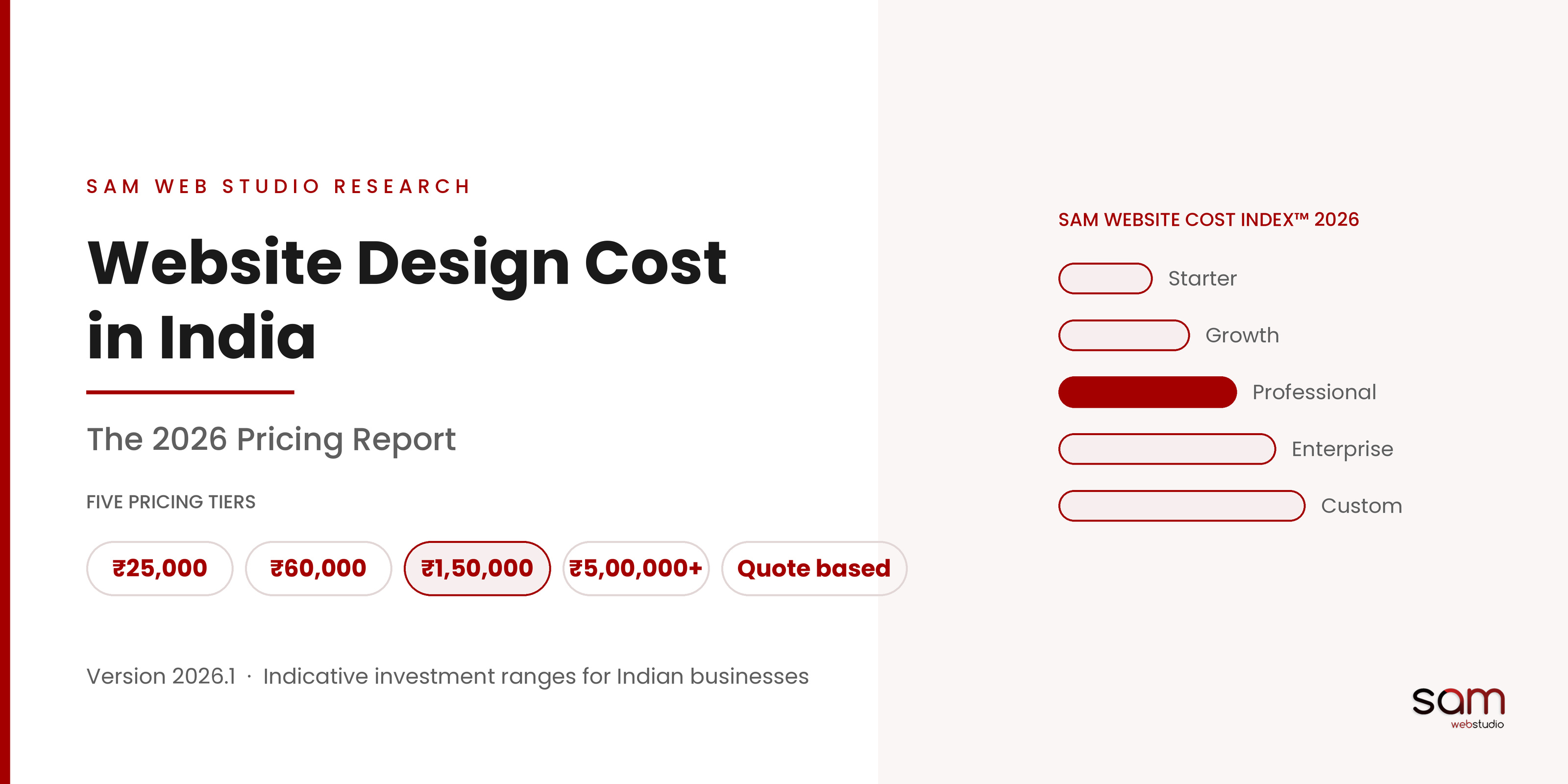
In India in 2026, a freelancer typically charges ₹8,000–₹70,000 for a standard business website; a company charges ₹60,000–₹5,00,000 for comparable work. Both models succeed and both fail in predictable circumstances. This guide identifies which you are in, gives you a five-factor framework to score your project, and sets out the protections that matter more than the choice itself.
Introduction: the decision that sets your costs for three years
A business owner in Pune recently asked us to look at his website. It had been built eight months earlier for ₹38,000 — a fair price for what was delivered. The problem was not the work. The developer had taken a full-time job in Bengaluru, the domain sat in his personal registrar account, there were no backups, and the contact form had stopped delivering enquiries roughly six weeks earlier. Nobody had noticed. Recovering control and rebuilding cost ₹1,64,000 and eleven weeks.
That is not an argument against freelancers. We have seen the mirror image just as often — a company charging ₹4,50,000 for a twelve-page brochure site that a capable individual would have built properly for ₹70,000, then billing for changes that should have taken minutes.
This decision does not really set your build cost. It sets your operating cost, your response time and your options for the next three years. A website is not a purchase in the way a printer is a purchase. It needs updating, patching, changing and occasionally rescuing, and whoever built it is almost always the cheapest person to do all of that. Choose badly and you pay twice — once for the build, once for the recovery.
Most articles on this question are published by agencies, and almost all of them conclude that agencies win. That is not our experience. We have referred work to freelancers when a client did not need us, and declined projects where our own process would have added cost without adding value.
If you have not settled on a budget yet, start with our breakdown of website design cost in India. This guide assumes you know roughly what you can spend and are deciding who to spend it with.
What actually differs between a freelancer and a company?
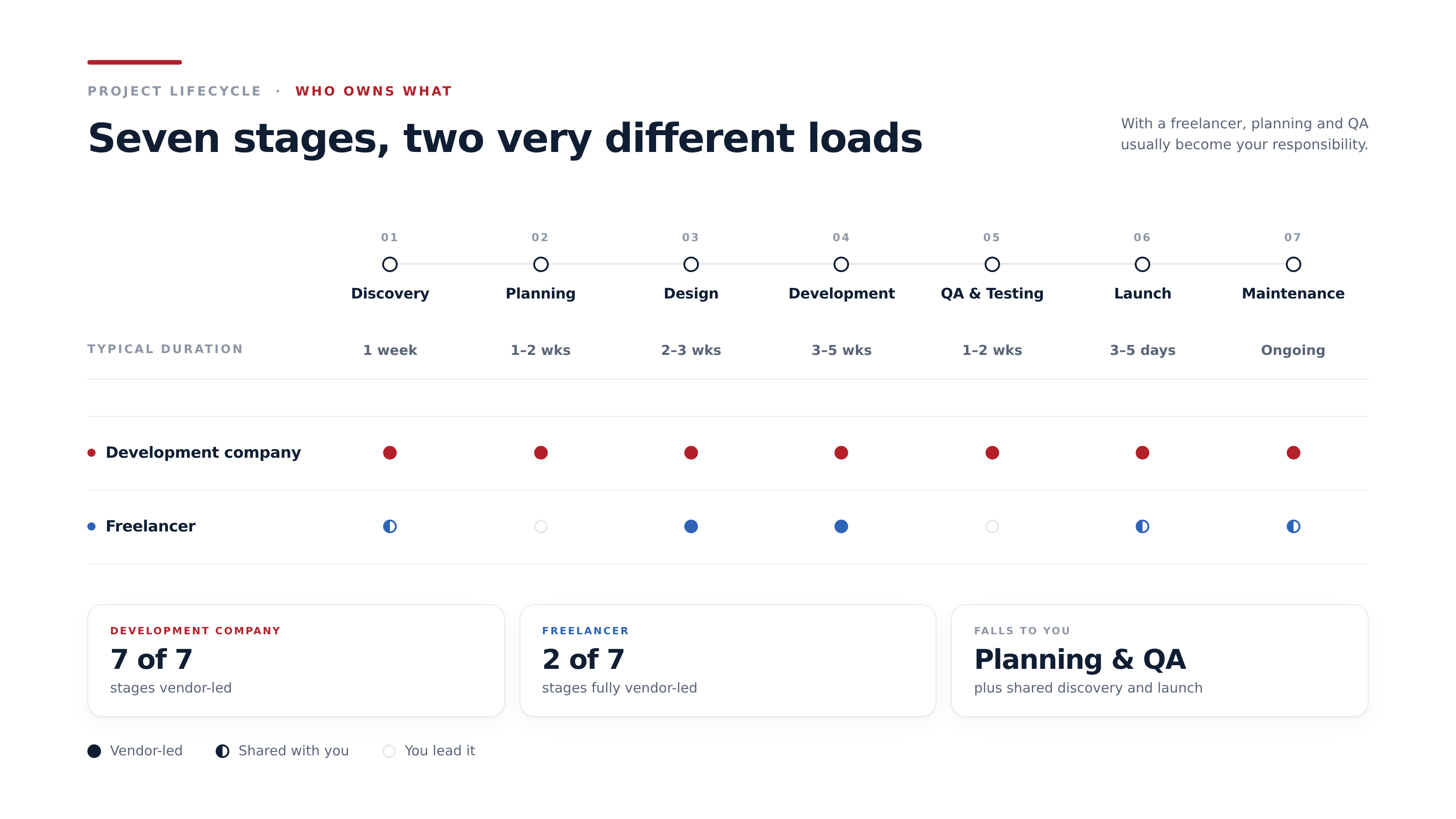
A freelancer gives you one person doing every role. A company gives you separated roles — someone designs, someone builds, someone tests, someone runs the schedule. That separation is the product, and it explains most of the price difference you will see.
| Factor | Freelancer | Web development company |
|---|---|---|
| Who does the work | One person, all roles | A team with separated roles |
| Who checks the work | Usually nobody | A dedicated tester |
| Who manages the project | You do | A named project manager |
| If that person is unavailable | The project stops | The team absorbs it |
| Written scope as standard | Sometimes | Always |
| Turnaround on a small change | Hours to days | Days to a week |
| Support after launch | Goodwill, then ad-hoc billing | Contracted, with response times |
| Documentation of how it was built | Rare | Standard practice |
| Accountability if it fails | Personal, hard to enforce | Contractually defined |
| Best-fit project value | Up to ₹1,00,000 | ₹3,00,000 and above |
Vendors on both sides skip one trade-off in that table. A freelancer's speed on small changes is a real advantage — no ticket, no queue, no account manager between you and the person typing. A company's process is exactly what slows that down. It is also what stops a poor decision from reaching your live site on a Friday evening.
What does each option cost in India?
For a standard business website, a freelancer typically quotes ₹25,000–₹70,000 and a company ₹1,50,000–₹5,00,000. Brochure sites start lower on both sides; e-commerce stores and custom applications run considerably higher.
Three adjustments matter more than the headline figures.
Add GST. A ₹1,00,000 quote from a registered vendor is ₹1,18,000 payable. If your business is GST-registered, that amount is usually recoverable — which narrows the gap against an unregistered freelancer who cannot issue a GST invoice at all. Confirm the position with your Chartered Accountant before you compare quotes.
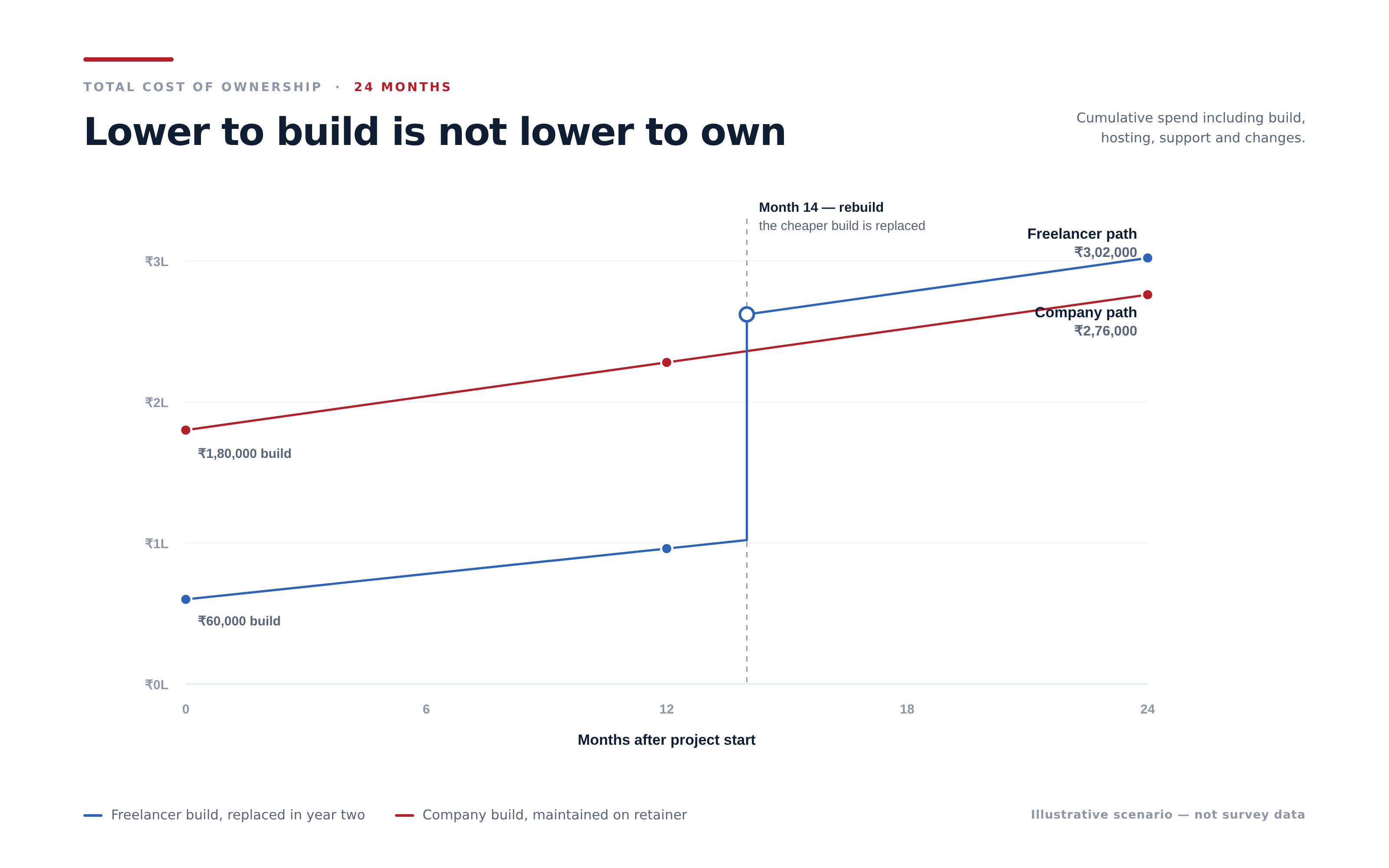
Compare two years, not the build. Hosting, domain renewal, licences, security updates and content changes all continue after launch. No adjustment changes the answer as often.
Budget above the quote. Photography, copywriting, product data and year-one changes rarely appear in a development quotation. Plan for 25–40% above the build figure in the first year.
If you want a fixed published figure to compare a quote against, our website packages list prices excluding GST.
When is a freelancer the better choice?
A freelancer is the better choice when the requirement is well defined, the budget is modest, and someone in your business can steer the work. In those conditions, a company adds process cost without adding proportionate value.
Hire a freelancer when:
- The site is informational. A brochure site, portfolio, professional services site or single-location restaurant page. No payments, no logins, no integration with other systems.
- You can manage the project. If you or a colleague can give feedback within a day and prepare content on time, you are already doing the project manager's job. Paying a company to duplicate it is waste.
- You need one skill, not a team. A designer to rework your identity, or a developer to fix a slow site. Buying a whole team to reach one specialist is expensive and slow.
- Your budget is tightly limited. Below roughly ₹60,000, most companies cannot deliver well without cutting corners you will not see. A ₹45,000 project handled properly by an experienced individual beats the same budget at the bottom of an agency queue.
- You expect to change things constantly. Early-stage businesses revising their positioning monthly are far better served by direct access to a builder than by a change-request process.
The catch is that a freelance engagement transfers the management burden to you. That is the actual trade for the lower price — not lower quality.
When is a web development company the better choice?
A company is the better choice when failure is expensive and recovery is slow. Process costs money, and it becomes worth paying once the cost of something going wrong exceeds it.
Hire a company when:
- The site does something, not just says something. Payments, bookings, logins, dashboards, or connections to your CRM, ERP or hospital systems. Complexity multiplies the ways a build can go wrong, and independent testing stops being optional.
- A missed deadline has consequences you do not control. An admissions window, an exhibition, a product launch. A company can add people to protect a date. One person cannot.
- The site handles sensitive personal, health or financial data. Responsibility for that data sits with your organisation, not your developer, so you need someone accountable for security patching, backups and incident response under a signed agreement.
- Nobody internally can run the project. Unmanaged projects stall, and stalled projects cost more than managed ones.
- Your procurement requires it. Institutions and enterprises frequently need a registered vendor, a purchase order and defined service levels. Check this with your accounts team before shortlisting — it can rule out individuals entirely.
The catch is the mirror image: you gain continuity and lose immediacy. A change a freelancer would make the same afternoon may take a week to clear a queue.
What are the real risks on each side?
Both models carry risk. They are simply different risks, and knowing which one you are accepting beats pretending either is safe.
The freelancer risk is availability. Illness, a new job, relocation or a larger client can pause your project with no escalation path, and knowledge of how your site works usually sits in one head, rarely written down.
The company risk is dilution. The person who impressed you in the meeting may never touch your project, and small projects can sit behind larger clients. Process that protects a ₹10,00,000 build can smother a ₹1,00,000 one — and some companies subcontract to the same freelancers you could have hired directly.
The risk both share is ownership. The most common recovery job we are asked to do involves a business that cannot access its own domain, registered in a developer's account rather than theirs. Whoever you hire, insist that the domain, hosting, source code and analytics accounts sit in your business's name. Confirm you can log into all four yourself before you release the final payment.
SAM Expert Insight
Set aside the words "agency" and "freelancer" and ask one question: how many people would have to disappear before my project stops? If the answer is one, you are buying a freelancer, whatever the vendor's website says. In many projects we have been asked to review, the client believed they had hired a company and had in fact hired one salesperson with a freelance bench. That is a workable model — but price it as a freelance engagement and put the same protections in place.
Practical example: a Coimbatore manufacturer choosing between two quotes
A pump manufacturer with around 180 products and a dealer network across four states came to us with two quotes for the same brief. A Chennai freelancer had quoted ₹55,000. A Bengaluru company had quoted ₹3,20,000.
The freelancer's quote was reasonable for what it described: a well-built WordPress site with a product listing and an enquiry form. The company's quote covered a structured product catalogue with filterable specifications, downloadable datasheets, a dealer locator, and enquiry routing that sent each lead to the correct regional sales manager.
The two vendors had quoted different projects. Neither was wrong. The client had written a brief vague enough that both readings were fair.
What settled it was not price. It was a question the owner had not considered: who updates the specifications when a product changes? Their catalogue changed several times a year, and nobody internally could edit a product page. The freelancer's build meant emailing him for every revision. The company's build put a form in front of the marketing coordinator.
They hired the company, but negotiated the scope down to ₹2,40,000 by removing a multilingual requirement they did not yet need. Eighteen months on, the marketing coordinator has updated the catalogue more than forty times without a developer.
The lesson is not that companies win. It is that a vague brief produces incomparable quotes. Had the owner written a one-page brief first — pages, functionality, who maintains it — both vendors would have quoted the same project, and the comparison would have taken an afternoon.
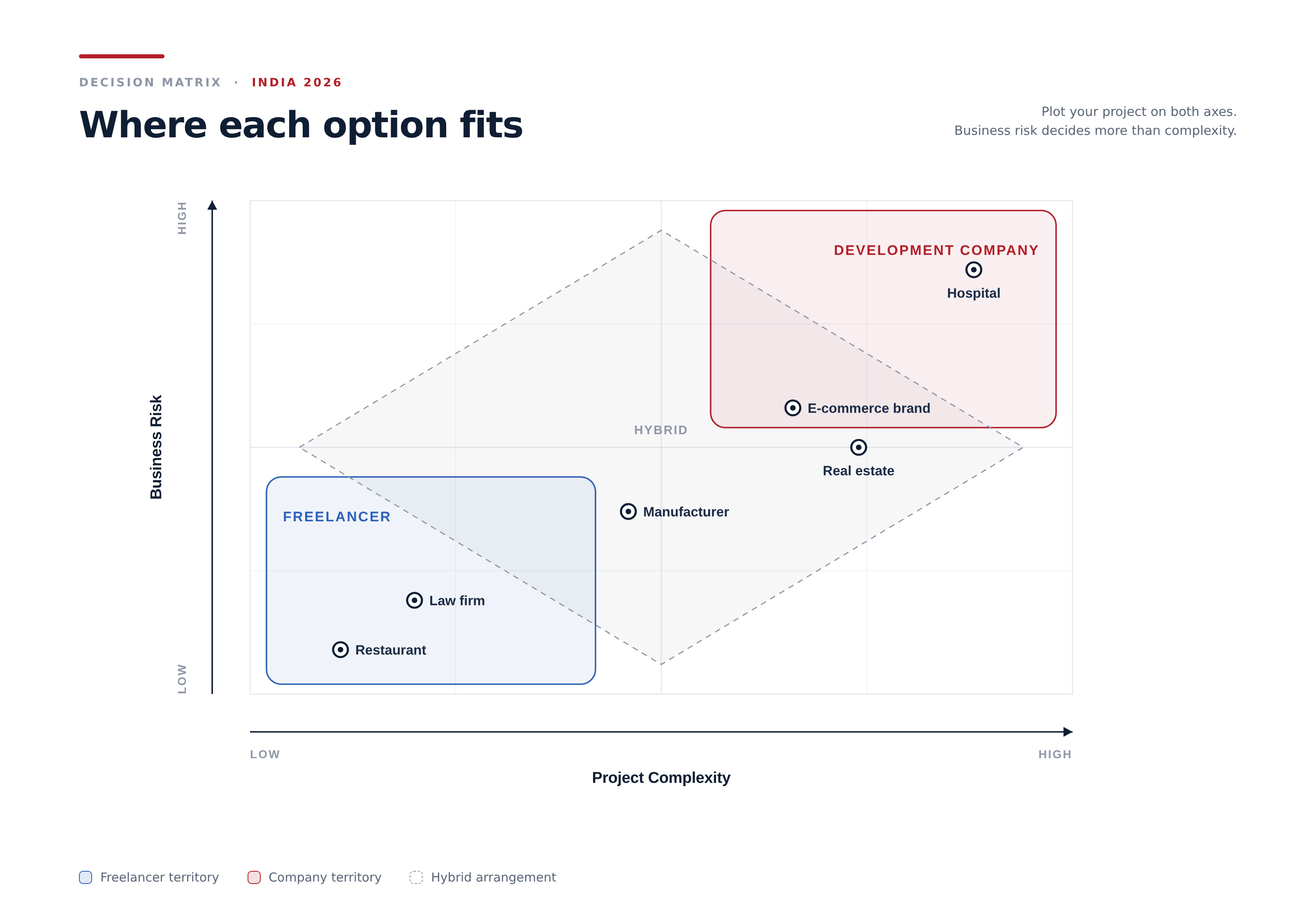
Where most Indian businesses land. Startups, law firms, consultancies, architects, single-location restaurants and individual schools are usually well served by a freelancer. Hospitals, colleges running online admissions, hotels with booking engines, real estate firms with live listings and enterprises with procurement rules are usually better served by a company. Manufacturers, exporters, B2B firms and growing D2C brands sit in the middle, where a small studio or hybrid arrangement works best.
The SAM C.L.E.A.R. Decision Framework™
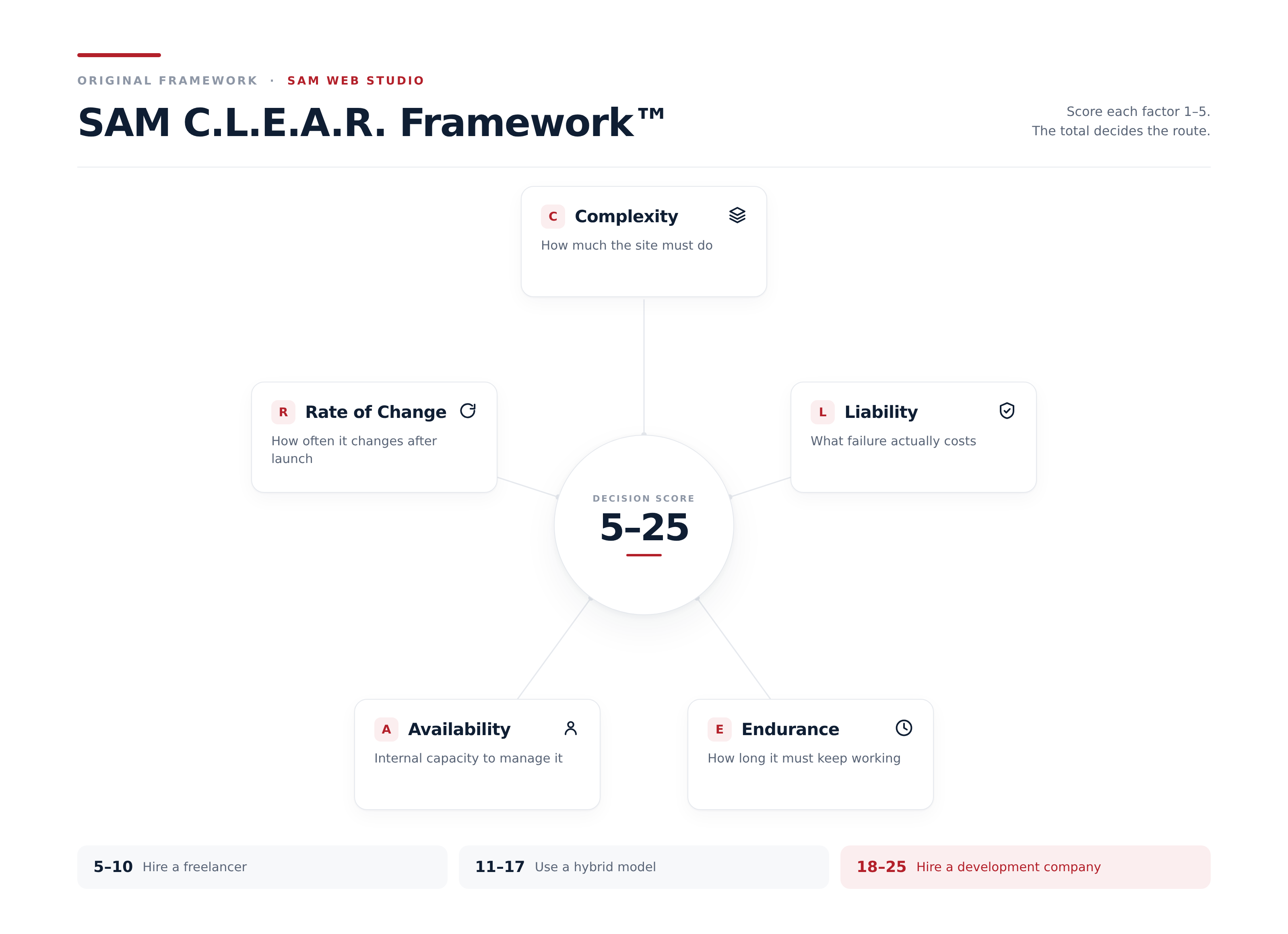
Score your project on five factors, one to five each. The total out of 25 gives you a clear recommendation, and it works whether your budget is ₹40,000 or ₹40,00,000.
- C — Complexity. How much does the site have to do? Score 1 for information pages only; 5 for payments, logins, dashboards and system integration.
- L — Liability. What does it cost you if this goes wrong? Score 1 for mild embarrassment; 5 for exposed patient, financial or legal data.
- E — Endurance. How long must the site keep working? Score 1 if you will replace it within a year; 5 if it is business-critical for three years or more.
- A — Availability. How much internal capacity do you have to manage it? Score 1 if a capable person has weekly time; 5 if nobody does.
- R — Rate of change. How often will it change after launch? Score 1 for a few edits a year; 5 for constant listings, stock or campaigns.
Reading your score
| Total | What it means | Route |
|---|---|---|
| 5–10 | A contained project with limited downside | Hire a freelancer |
| 11–17 | Real stakes, but not on every axis | Use a hybrid — one builds, another supports or audits |
| 18–25 | Failure is expensive and recovery is slow | Hire a development company |
Two scoring errors account for most wrong answers. Businesses under-rate Liability because they think about the site failing and forget about the data inside it. They over-rate Rate of change out of optimism — score what you actually changed in the last two years, not what you intend to.
Score it twice: once yourself, once with the person who will manage the project day to day. Those two scores diverge most on Availability, and the second is almost always the accurate one.
Common mistakes and what they cost
Seven errors account for most of the money wasted on this decision — and none involves choosing the wrong type of vendor.
Comparing quotes without a common brief. As the Coimbatore example shows, vendors quote what they think you meant. Send an identical one-page brief to everyone and the price spread usually collapses into something explainable.
Judging on build price alone. A ₹30,000 site replaced within a year costs more than a ₹90,000 site that lasts four. Compare 24-month totals.
Letting the vendor register your domain. You cannot renew, transfer or move a site you do not control — it is why the Pune recovery took eleven weeks rather than a few days. Register the domain yourself, in your business's name, before the project starts.
Treating an NDA as ownership. An NDA protects confidential information. It does not transfer rights to the code you paid for — that needs a written assignment clause in the agreement.
Paying 100% in advance. You lose all leverage the moment the money moves. This appears in more of the disputes we are asked to resolve than any other single factor.
Accepting "unlimited revisions." Undefined scope becomes a disagreement, then a stalled project. Define revision rounds and what counts as a new change.
Leaving content until development starts. Photography and copy delay Indian web projects more than anything else, and never appear in the quote.
Checklist: before you sign anything
- A one-page written brief sent identically to at least three vendors
- Domain registered in your business's name, with you holding the login
- Hosting and source code in accounts you control
- Three live portfolio sites verified, two client references called
- GSTIN or company registration verified on the relevant government portal
- Written scope of work, stating clearly what is excluded
- Milestone payments, with 10% held back until handover is complete
- Ownership transfer clause covering both code and design files
- Support terms and response times stated in writing
- Your Chartered Accountant has confirmed the GST and TDS position
For the vetting stage itself, our note on the five basic parameters to check in a development company covers what a good answer looks like.
Frequently asked questions
Is a freelancer always cheaper than a web development company?
Cheaper to build with, almost always. Cheaper to own, not always. If the site needs rebuilding within eighteen months, or support gaps cost you enquiries, the cheaper build becomes the more expensive decision. Compare two-year cost rather than the quotation figure.
What happens if my freelance developer stops responding?
If you hold the domain, hosting and source code, you can hand the project to someone else within days. If the developer holds them, recovery is slow and occasionally impossible. The risk is not their competence — it is your lack of options if the arrangement ends badly.
Do web development companies outsource work to freelancers?
Some do, and that is not automatically a problem — many capable companies use trusted specialists. It becomes a problem when hidden, because you are then paying an agency margin for a freelance engagement. Ask directly who will do the work.
Who owns the code and design of my website in India?
Not necessarily you. Under Indian copyright law, work by an independent contractor generally remains theirs unless there is a written assignment. Paying an invoice does not transfer copyright. Include an ownership clause in every agreement, and have a lawyer review it for anything substantial.
Do I have to pay GST on website development?
Services from a GST-registered vendor attract GST on top of the quoted amount. Whether you can recover it depends on your own registration status. An unregistered freelancer cannot charge GST at all. Ask your Chartered Accountant to confirm the position before you compare quotes.
How much does website maintenance cost each year in India?
Roughly ₹12,000–₹40,000 with a freelancer and ₹30,000–₹1,20,000 with a company for a standard business website. E-commerce stores and custom applications cost more. A meaningful agreement covers hosting, security updates, tested backups and a stated allowance of changes. If the site is already dated, price a redesign separately rather than folding it into support.
Can I hire a freelancer to build the site and a company to maintain it?
Yes, and it works well — provided the freelancer builds on a standard platform and hands over documentation. Agree this at the start, because retrofitting documentation onto a finished project rarely happens voluntarily.
Is it safe to hire a freelancer for a business-critical website?
It can be, under three conditions: you own the domain and hosting, the source code sits somewhere you control, and payment is tied to milestones with a portion held to handover. With those in place, the worst case is inconvenience rather than loss.
How long should a business website take to build?
Two to four weeks for a brochure site, four to eight for a business site with a content management system, six to twelve for an online store. Content that is not ready delays Indian web projects far more often than development does.
How do I know whether a quote is fair?
Check three things: does it state what is included and excluded; does it separate design, development, content and testing; does it say what happens after launch. A quote failing all three is a number, not a quote. Where two quotes for the same brief differ by more than 2.5×, the difference is almost always scope.
Making the decision
There is no universally correct answer here, and any article offering you one is selling something.
If your project is well defined, your budget is modest, and someone in your business can steer the work, hire a good freelancer. If your project is complex, your deadline is fixed, your site handles sensitive information, or your business cannot afford for it to break, hire a company. If you sit between the two — as most growing Indian businesses do — a hybrid arrangement is not a compromise but often the right structure.
Whichever way you go, the protections matter more than the choice. Own your domain. Write down the scope. Pay in stages. Collect everything at handover. Businesses that do those four things recover from hiring the wrong vendor in weeks. Businesses that skip them can be trapped with the right one.
Talk it through before you commit
If you have quotes in hand and cannot tell which is right, send them to us. We will walk through what each scope actually covers, where the risk sits, and what the two-year cost looks like, and you can see how we have handled projects like yours first. That includes telling you when the honest answer is that you do not need a company like ours.
No obligation, and no proposal at the end of it unless you ask for one.
→ Discuss your project requirements with our team → Send us a quote you have received for an independent read
SAM Web Studio designs, builds and supports websites for businesses across India. This article is general guidance, not tax or legal advice. Please consult your Chartered Accountant or legal adviser on matters specific to your business.