


20, Aug 2026
Why AI Search Ignores Most Delhi Business Websites
A person doing business in Delhi opens ChatGPT or Google's AI Mode and types the question a customer would ask. Who in Delhi does this kind of work? Three or four companies come back. One of them has a website that looks cheaper than theirs, and theirs is not one of them.
So the website must be the issue. Sometimes that is true. Most of the time it's one specific, fixable part of it. And sometimes the site isn’t even the problem.
A note on the title. "Most" is an editorial framing, based on patterns that keep popping up in the way business websites are built. There is no published study telling us how many business websites in Delhi are affected and this article will not pretend otherwise.
What it means for a website to be AI-readable
Readable means two things and either one can cause a site to fail. A system has to load your page and find real text in it. Then that text needs to give it a reason to use your page, not one of the dozens covering the same ground.
It helps to know what is going on below. Google says its generative AI features are built on the same core Search ranking systems as everything else. Grounding means that the system pulls pages from the Search index and answers from what those pages say. Query fan-out means one question quietly becomes several, so your page is competing for search terms that nobody actually typed.
Two very different problems give the same symptom.
Problem A. The system cannot properly access or interpret the page. Your site is loading correctly on Chrome. What the system gets is a page with little or no usable text, or no successful response at all. The good news is that these are mechanical failures. The tests are yes or no and the fixes are often fast and cheap.
Problem B: The page is readable by the system, but there's little incentive to choose it. Everything is intact here. The page says what every competitor's page says. That's an editorial failure and no setting anywhere will change that.
Both look the same from where you're sitting so the order is important. You rewrite the copy of a page you can't read and you've spent weeks on words nothing will see. You have solved a problem you did not have. Re-engineer delivery on a page that reads well but says nothing. First access. Second selection.

This will be sold as AEO (Answer Engine Optimization) or GEO (Generative Engine Optimization). Google says that optimizing for its AI features is still SEO for Google Search. Regardless of labels, in practice it’s that same order: make the page readable, then make it worth selecting.
Signs that a website is AI-invisible
Access problems typically present themselves as follows:
The URL Inspection tool in Search Console reports that the page is not indexed.
Very little body text in page source, mostly script tags.
The robots.txt file that tells crawlers what they can fetch has Disallow rules that no one can explain.
Your developer is seeing 403 or 429 responses to crawlers in the logs.
One thing is missing from that list on purpose: no impressions in the generative AI performance report in Search Console. That can just be low traffic. Or a selection problem. Or a report that has not yet reached your property. On its own, it proves nothing about blocking.
Selection problems are not like that at all:
Change your company’s name to a competitor’s and nothing in the copy is false.
No prices, timelines, locations or named processes anywhere on the site.
Nothing on it could only have been written by someone who does the work.
5 reasons AI will skip a site in design and build
All five are design and build issues. Later come the self-check, settings and server problems.

Heavy pages, slow loading
Google has three metrics for how a page performs for real visitors, rolled into the name Core Web Vitals: the time it takes for the main content to appear, how quickly it responds to a tap and how much the layout jumps around. All three are graded on data from real visitors, not what a tool says about a single machine.
But be aware of the limit. Google does not specify a threshold at which a site is no longer eligible for its AI features. Speed is a page experience and visitor issue, not a gate. It bites indirectly: website speed of Delhi businesses is determined on a mid-range phone with patchy data, where six sliders, four tracking scripts and a four-megabyte hero image give you more that can fail.
No obvious headings or structure
Heading is not a font point size. It is a claim about what follows. Many sites have only one H1, followed by styled divs that look like headings, forcing anyone reading the page to guess where one thought ends and the next begins.
Pick any section on its own. Still makes sense? That’s all structured website design asks for. Clear sections, honest headings. It's not chopping content into pieces because somebody says AI needs a certain chunk size. It’s not compulsory.
Content that appears only after the scripts have run
A JavaScript-built site is not automatically invisible. Google reports that Googlebot executes JavaScript. Both Anthropic and OpenAI document what their crawlers are for, but say nothing about whether they execute it. The wrong question is which framework you used. The right question is what the page returns, and to which system.
Google documents that Googlebot renders JavaScript using a headless Chrome-based service, so content that only appears after scripts are run can still be indexed.
OpenAI details its crawlers by purpose: GPTBot for training, OAI-SearchBot for ChatGPT’s search feature, ChatGPT-User to fetch a page on request. Anthropic documents ClaudeBot, Claude-SearchBot and Claude-User in the same way. As of the last check of this article in September 2026, neither documents whether they execute JavaScript.
Independent testing published through 2026 suggests several retrieve raw HTML only. This is not vendor confirmation but independent evidence. The behavior of some crawlers has never been published or tested.

So React and Next.js aren’t the villains. Delivery is. Render a page server-side or prerender it, and on the first request, it will return full HTML. Instead build everything in the browser and that response might be an almost empty shell. Verify page by page. The framework’s name says nothing.
Meaning shown by images, slideshows and PDFs
The price list is a jpg. The service descriptions are displayed in a rotating banner. The company profile is a PDF file. A person reads all of it quite happily. A system finds a few alt attributes and a link, nothing more. If a customer needs a fact, it has to be in text.
A mobile version with less information than the desktop
Google primarily indexes the mobile version of the page. If a build hides sections on small screens, or just shortens the text, the short version is what gets indexed, and whatever is missing there is missing everywhere. Worth a look anywhere mobile-first web design meant cutting things out on phones.
What an AI-ready build looks like
“An AI-ready website is not a different type of website. It is a site whose important content is accessible, well organised, technically sound, and useful to the people and systems trying to understand it."
Design fixes that make it easier for AI to read
Main content in the first HTML response, as text.
Ordered real heading elements.
Text facts: prices, timelines, service areas, contact info.
Desktop and mobile have the same content.
A performance budget you actually follow, particularly for images and scripts.
One clean sheet per topic, no near duplicates.
Most of that is editing work you can do today. One thing is not. If a page gives you content in the first response, that’s a rendering decision made at build time. If you want to change that, that’s development work, not a content update. Just make sure you get a straight answer on that before you commission anything.
What you don’t need to make
Google is very clear on what you can skip. All of the following is specific to Google Search; other products may differ.
llms.txt: not needed for Google Search, which does not use it. This is a statement about Google, not about every system that reads your site.
Chunking: not required. Clear sections and headings help readers. Artificial fragmentation is something else.
Rewriting for AI: Standard content doesn’t need a special style for artificial intelligence systems.
Structured data: not needed for Google’s generative AI features, but still helpful for supported rich results in Search.
Artificial mentions: chasing these isn’t as useful as it sounds.
None of that is an argument against schema or careful writing. It’s about the order. Build the accessible, useful, well-structured site first.
Quick self-check before hiring anyone
Six checks, cheapest first. Most of it is free. Run them before you take a quote from anyone, us included.

1. Is the page indexed and eligible to show a snippet? To qualify for its AI features, a page must be indexed and qualified for the Snippets feature in Search, says Google. Search Console’s URL Inspection tool tells you if Google has it indexed. A quoted-sentence search is a quick sanity check, but not finding it proves nothing. About snippets: noindex prevents a page from appearing in Search, nosnippet prevents a text preview, and data-nosnippet marks parts not to be previewed. All three can also be delivered as HTTP headers, which you won't see in the page source, so have a developer check both. Free.
2. Is your site included in AI features? Search Console has a Search generative AI control under Settings. Include is the default, and a property can be set to Exclude, which keeps your links and content out of AI Overviews and AI Mode. A subdomain or folder property inherits this value from its parent unless you override it. Google rolled this control out to all sites worldwide on 31 August 2026. Alongside it, robots.txt for Googlebot plus nosnippet, data-nosnippet and noindex control what gets crawled and shown. Free.
3. Does your content actually exist in HTML? View the page source and look through it for a sentence that you can see on the screen. Find it and that sentence is there in the first response, visible to any system that reads raw HTML. Google renders JavaScript, so not seeing it does not mean the page is invisible. It means the text comes later, which matters for systems that may not wait. If there is no service copy, ask how the page renders.
4. Is robots.txt allowing the right crawlers? Open yourdomain.com/robots.txt and see if there are Disallow rules for crawlers. That’s where costly mistakes happen: blocking a training crawler and blocking a search crawler are two different decisions. Anthropic says blocking Claude-User may impact a site’s visibility for user-directed web search, while OpenAI lists GPTBot and OAI-SearchBot as distinct options. So a site that broadly blocks AI related crawlers may also block itself from systems the owner wanted to reach. Free to read. A crawler access problem like this is usually a small fix.
5. Is your server letting them in? Permission in robots.txt is not permission from the server. A firewall, security module or CDN rule can return 403 or 429 to a crawler that the robots file allows, and on shared hosting a server-wide default can do it without anyone on your side changing anything. This is not to be tried with a spoofed request, the result is easy to misread and some hosts consider it hostile traffic. Ask your developer or host to check the logs for these crawler user agents and the HTTP status codes they received.
6. Does the content give a reason why the system would select it? Read your copy along with two or three competitors’ and then take the substitution test below. Interchangeable copy means nothing is broken, nothing is separating you: a content problem, not a technical one.
The substitution test
Replace a competitor’s name in your home page copy. And if a lot of it still looks true, there is no incentive for a system trying to pick between similar pages to pick yours. That just shows a weakness. That’s not to say the system will skip your site and no rewrite means you’ll get a mention.
SAM Expert Insight
We tested it on our homepage. The results were hit and miss. The bits that describe how we actually work would fold under a competitor’s name. But several blocks around them survived the swap untouched. “Transparent pricing” or “creative thinkers” or “commitment to delivering quality” are things you could find on anyone’s site. These are in our rewrite queue.
The six checks leave out something. And when your queries are from people searching near you, your local listing is part of the same picture. Google states that the business information you submit in your Google Business Profile can help your visibility in both AI answers and regular results. So watch that, and watch your website.
If you cannot perform these checks
For some small businesses in Delhi and NCR, the problem isn’t even the website. No one on your side has access to the systems that power it. If you do not have Search Console, hosting or registrar access, obtaining those credentials comes before any redesign. Write and inquire.
Three questions to ask any developer, current or future.
Does this page return its main content in the first HTML response, or after scripts have run?
What is in our robots.txt and why is each rule there?
Do we have access to Search Console? What status codes are crawlers getting from our server?
Vague answers tell you something too.
Build or repair
Almost everything here is a patch. One setting. A text file. A word to your host. The honest answer is that a rebuild is needed only in a much narrower set of cases.
Take this to a developer, an agency or a digital marketing company, and the work should follow the same order rather than open with a quote. Check the page. Make sure it gets indexed and given a snippet. First check HTML response, robots.txt and logs. Only then determine if the problem is technical or editorial. Fixes before rebuilds. If a rebuild is the answer, choosing a website designing company in Delhi is one decision worth taking slowly.
Frequently asked questions
Will ChatGPT mention my business based on web design?
Partly, and in one direction only. If the content on a page only appears after scripts have run or the key facts are hidden behind images and PDFs then design can get in the way. A system pulling raw HTML may have little to work with. But design alone cannot manufacture a citation. Once a page is readable, it's a matter of whether it has anything worth citing. Configuration is not a promise.
Do I need a new website or some fixes?
Usually just fixes. Most of the six checks are settings, text files or edits, several costing nothing. Start there, and measure before you spend. In Delhi, a website redesign is necessary when the site cannot return its content in the first response without being rebuilt, when the platform can no longer be safely updated, or when editing the copy requires rewriting it. If you get a redesign quote before anyone has read your robots.txt, ask why.
How fast should a business website load today?
Google’s Core Web Vitals benchmarks: LCP of 2.5 seconds or less, INP of 200 milliseconds or less and CLS of 0.1 or less. These are scored at the 75th percentile of real visitor data, over a rolling 28 day window. Hence why a fix takes weeks to show, and why the headline score of a speed tool is not the verdict. Verify the data in the field in Search Console. Note: There is no speed threshold for AI eligibility from Google. Speed is important to visitors and page experience and that alone is reason enough.
Get a second opinion before you rebuild
If you have run the six checks and still cannot tell whether the problem is access or selection, send us the URL. We will tell you which one it is, what it would take to fix, and whether you need us at all.
No obligation, and no proposal unless you ask for one.
→ Send us your URL for an honest read → Discuss your website with our team
This article is general guidance based on Google, OpenAI and Anthropic documentation as of September 2026. Platform behaviour changes, so check current documentation before acting.

Manish Bhardwaj
Head of Digital Marketing, SAM Web Studio
SEO Strategy·Technical SEO·Answer Engine Optimisation·Generative Engine Optimisation·Content Strategy
Manish Bhardwaj leads digital marketing at SAM Web Studio, where he has worked since 2012. He heads the agency's SEO practice and its work in answer-engine and generative-engine optimisation, alongside content strategy and lead generation for clients in India, the UAE, Hong Kong, the UK, Canada and the United States.
He writes about search as it actually behaves — what changed, what did not, and which tactics are worth a business's time.
Table of Contents
What it means for a website to be AI-readable
Signs that a website is AI-invisible
5 reasons AI will skip a site in design and build
What an AI-ready build looks like
Design fixes that make it easier for AI to read
What you don’t need to make
Quick self-check before hiring anyone
The substitution test
If you cannot perform these checks
Build or repair
Frequently asked questions
Get a second opinion before you rebuild
Latest Blogs
Website Development Company vs Freelancer in India (2026): Which One Should You Hire?
Website Design Cost in India: The 2026 Pricing Report
A Complete Guide to Shopify Agentic Commerce in 2026 for Online Brands
Top 7 Website Design Trends in 2026 Every Business Should Know
Mastering AI SEO: Your Comprehensive Guide for 2026
Categories
Related Blogs

19, Aug 2026
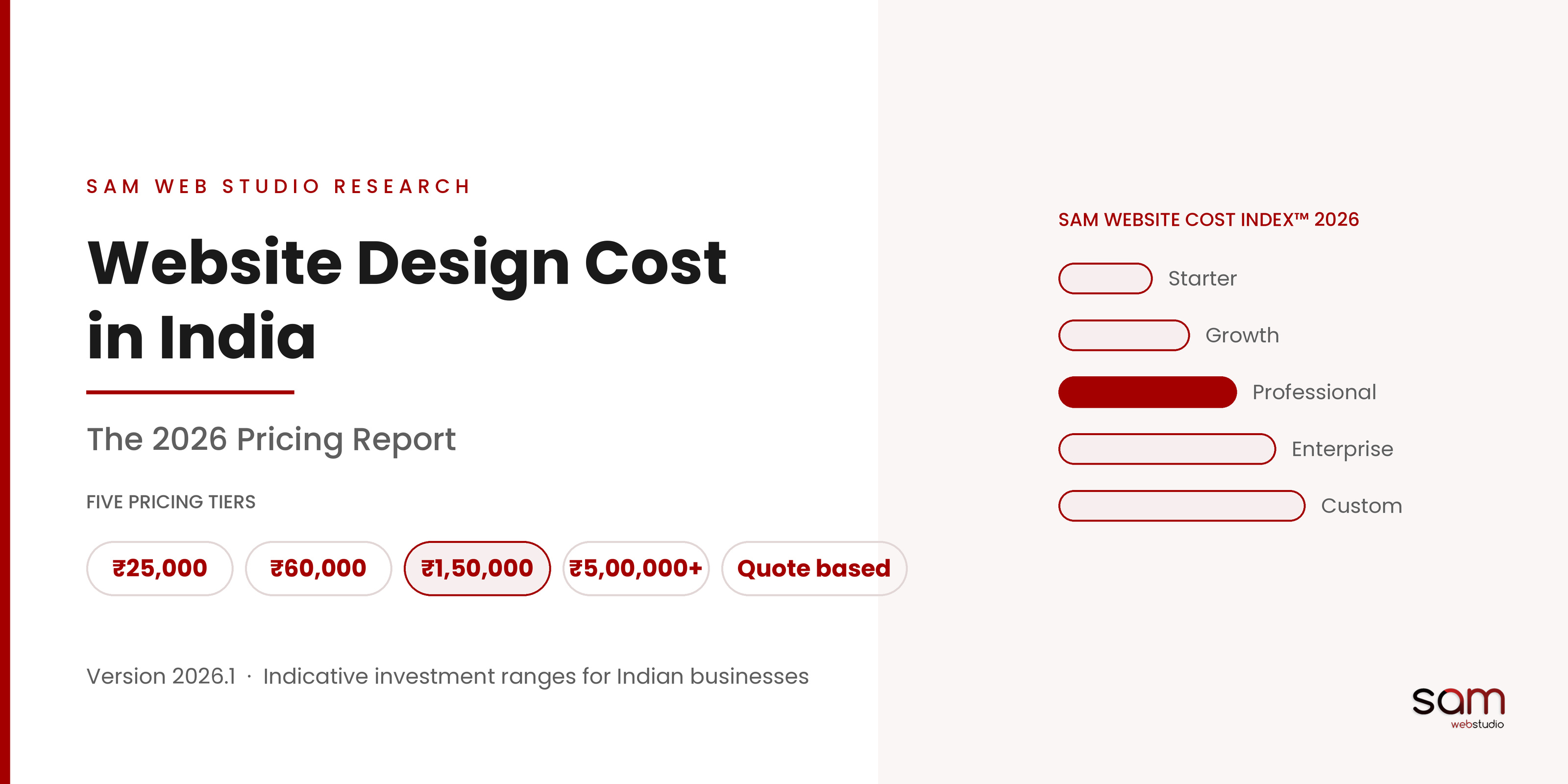
Website Design Cost in India: The 2026 Pricing Report

13, Feb 2026
Top 7 Website Design Trends in 2026 Every Business Should Know

26, Jul 2017
Needs A Good Website? Hire The Best Website Designing Company
14, Apr 2017
Looking To Increase Your Website Conversion Rate? Tips Here
03, Apr 2017
Understanding The Concept of SEO Friendly Websites

16, Mar 2017
Analysing Different Elements in Web Designing

10, Feb 2017
How To Design An Interactive Landing Page
02, Feb 2017
How WordPress Plugins Help In Improving The Designing of The Website

01, Feb 2017


